

You were handed the puberty unit in a staff meeting, maybe with a binder or a login and a date on the calendar. What you were not handed was training. Many elementary teachers move through certification with little or no preparation in how to teach puberty or sexual health, and then they are asked to stand in front of a room of ten and eleven year olds and do it well.
If that gap is sitting in your stomach right now, you are not behind. You are in the same position as nearly every teacher who has ever been assigned this subject. One of the most common things we hear from teachers sounds like a confession: “How can you expect me to teach this when I don’t know how?” It is a fair question, and the answer is not “become an expert.” The answer is to get prepared in a way that fits a real teacher’s budget, calendar, and nerves.
Why Teacher Preparation Decides Whether a Curriculum Works
A school can adopt the best-designed curriculum available and still see it fall flat. The reason is rarely the lessons. It is preparation. Studies of how sex education programs are implemented point to the same pattern: teacher preparedness is one of the strongest determinants of whether a curriculum is taught the way it was designed. A confident teacher follows the method, handles the hard moments, and keeps the room steady. An anxious teacher skips the uncomfortable parts, rushes the sensitive lessons, or quietly avoids the unit altogether.
This matters for everyone in the building. For teachers, preparation is the difference between dreading the unit and finding it manageable. For administrators and curriculum directors, it is the difference between a program that delivers consistent instruction across classrooms and one that varies widely depending on who is teaching it. Preparation is not a soft factor you address if time allows. It is the variable that decides whether the investment pays off.
The Real Cost of Traditional Professional Development
When schools think about preparing teachers for a sensitive subject, the default image is a workshop: a trainer, a conference room, a day out of the classroom. That model has its place, but the costs add up quickly. Registration fees, travel, and substitute coverage can climb into the thousands for a single team, and every training day is an instructional day lost.
There is a quieter cost too. A one-time workshop happens once, often weeks or months before the lessons begin. By the time a teacher opens to the first puberty lesson, the energy of the training has faded and the specific worry of the moment (“What do I say when a student asks about this?”) is back. The workshop built general knowledge, but it left the teacher alone at the point of delivery. For a subject where the fear lives in the unscripted moment, that timing gap is a real problem.

What Affordable, Effective Training Actually Looks Like
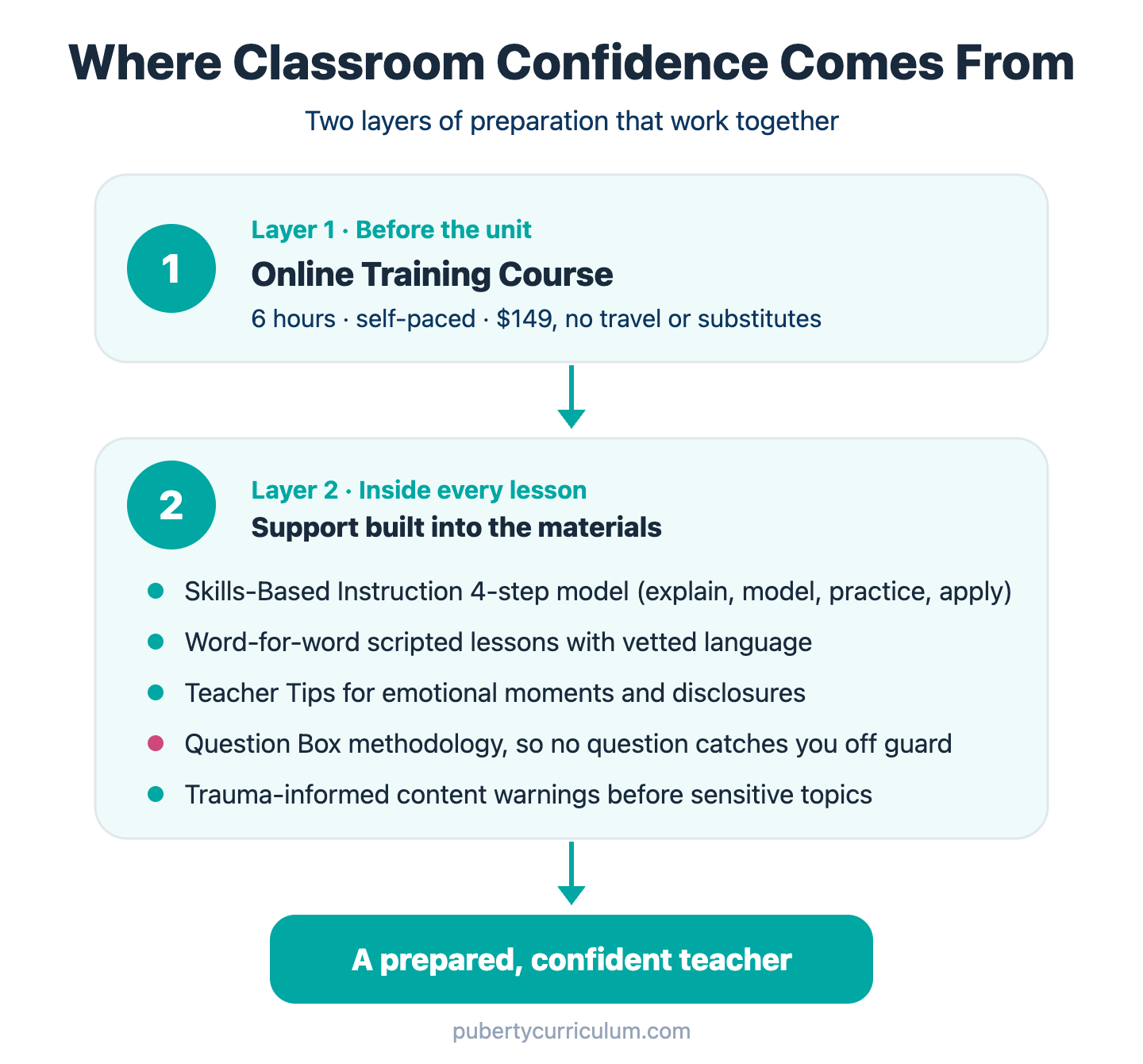
Good preparation no longer requires a travel budget. PWY’s self-paced Online Training Course gives teachers six hours of professional training for $149, available 24 hours a day, so a teacher can work through it on a weekend, over a few planning periods, or during a slow week before the unit starts. It covers the things that actually drive classroom confidence: content knowledge, teaching strategies for sensitive topics, how to handle student questions, the common pitfalls to avoid, and how to set up a safe classroom climate from the first lesson.
The economics change the conversation. Instead of asking a principal to fund a workshop for the whole team, a single teacher can prepare themselves for the cost of a few classroom supplies, and a school can train an entire grade level for less than the price of one traditional training day with substitutes. For administrators weighing a purchase, that affordability is part of what makes the program defensible at budget time, and it is one of the factors worth weighing when evaluating a puberty curriculum.
The shift: Affordable, self-paced training removes the budget barrier. The deeper source of confidence, though, is what happens inside the lesson itself, every time a teacher opens the materials.
Confidence Comes From the Lesson, Not Just the Workshop
Training builds a foundation. Lasting confidence comes from knowing that support is waiting inside every lesson, every time you open the materials. This is where preparation becomes durable, because it is no longer something you remember from a workshop; it is something the curriculum carries with you.
PWY is built on the Skills-Based Instruction 4-step model: explain, model, practice, apply. Every lesson moves through the same four steps, so a teacher follows a consistent process rather than improvising a new approach for each topic. The lessons are scripted with developmentally appropriate language, which means the words have already been vetted and a teacher does not have to invent phrasing for a delicate subject on the spot.
For the moments that worry teachers most, two features do the heavy lifting. Teacher Tips are embedded throughout each lesson, giving real-time guidance for handling emotional reactions, sensitive disclosures, and classroom dynamics as they happen. And the Question Box methodology removes the single biggest fear teachers name, the fear of being asked something they cannot answer. Every student writes a question or comment at the end of each lesson, which protects the anonymity of the students who genuinely need to ask. Teachers review the questions between lessons and prepare answers using a set of 30 or more model questions and answers, then respond at the start of the next lesson. The teacher is never caught off guard, because they always have time to prepare and a model answer to lean on.
Trauma-informed content warnings round out the support, signaling sensitive topics before they arrive so a teacher can set up the room with intention rather than surprise. Taken together, these features mean a teacher does not have to hold everything in their head. The hardest parts of the job are scaffolded into the materials they use every day.
A Practical Path to a Confident Puberty Teacher
Preparation works best as a sequence, not a single event. Here is a simple path any teacher or administrator can follow before the unit begins.
| Step | What you do | Why it works |
|---|---|---|
| 1. Train before you teach | Complete the self-paced Online Training Course in the weeks before the unit. | The content and strategies are fresh when lessons start. |
| 2. Read the script before the room | Walk through each lesson’s teacher script and Teacher Tips ahead of time. | The language feels familiar, not improvised. |
| 3. Prepare answers between lessons | Use the Question Box review to anticipate questions and rehearse with the model answers. | You are never caught off guard in the moment. |
| 4. Lean on the warnings | Note the content warnings before sensitive lessons and plan how you will open the room. | You set the tone with intention instead of surprise. |
| 5. Debrief and adjust | After each lesson, jot down what worked and what felt shaky. | Confidence compounds; dread gives way to routine. |
None of these steps requires becoming a sexual health expert. They require a curriculum designed to prepare ordinary teachers and a few hours of intention before the unit starts. That combination is what turns “I don’t know how to teach this” into “I have got this.”
You do not need to be a sex education expert to teach sex education well. You need preparation that respects your time and a curriculum that supports you in the moment.
If you want to see how PWY prepares teachers, request a free curriculum preview and take a look at the Online Training Course, the scripted lessons, and the Teacher Tips for yourself.