

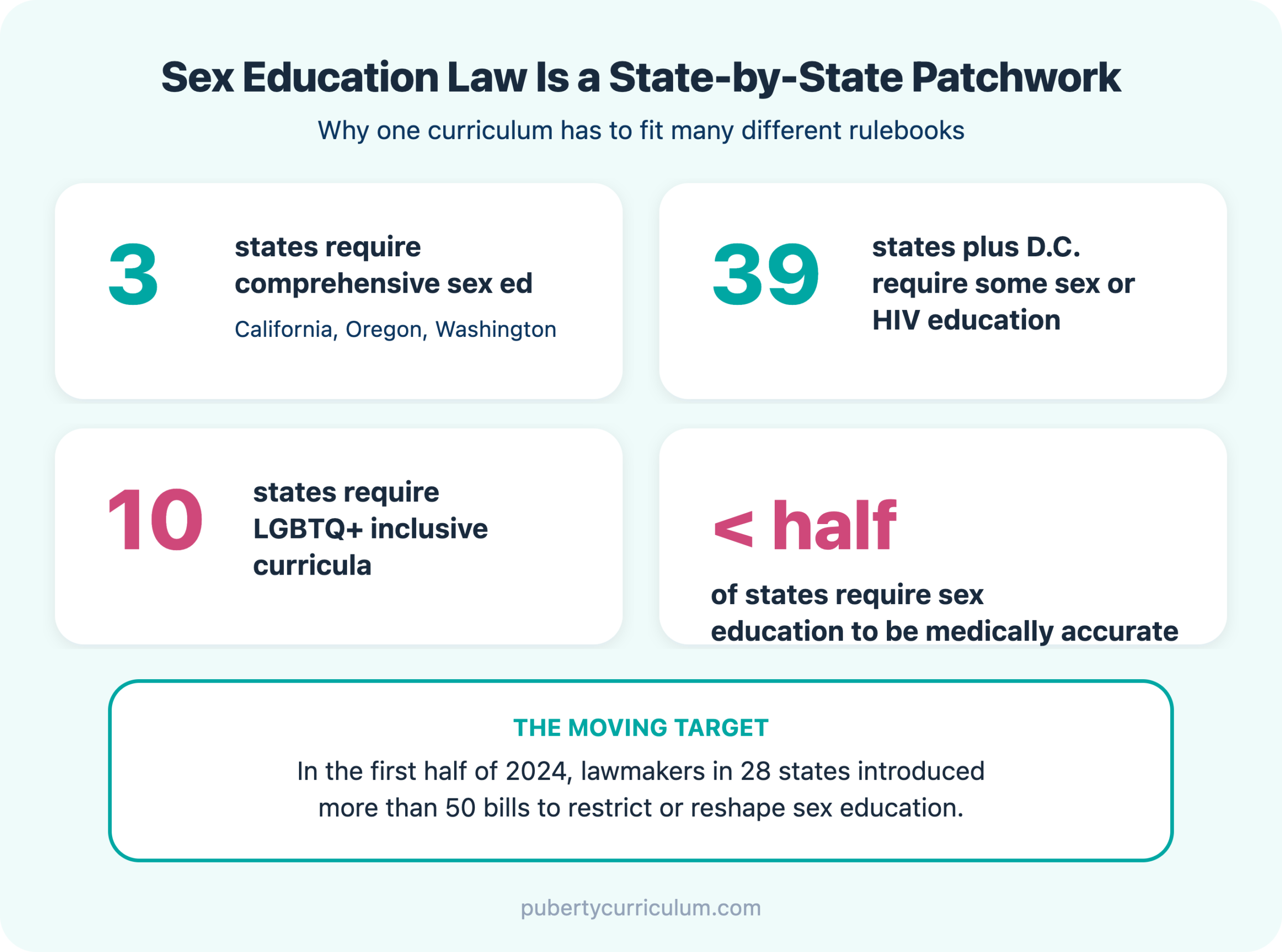
As of early 2026, just three states require schools to teach comprehensive sex education, according to national sex education policy tracking. Thirty-nine states and the District of Columbia require some form of sex or HIV education, but the scope and quality vary so widely that two districts a few hours apart can operate under opposite rules. In the first half of 2024 alone, lawmakers in 28 states introduced more than 50 bills to restrict or reshape what schools can teach. If you are choosing a puberty curriculum, you are not choosing it for one rulebook. You are choosing it for a moving target.
Curriculum directors feel this more acutely than anyone. You are asked to recommend a program that satisfies your state’s current law, survives a school board’s questions, respects what families expect, and still holds up if the legal ground shifts a year from now. That is a lot to ask of a single product. The good news is that the right evaluation criteria make this manageable. The deciding factor is rarely the curriculum’s subject matter itself. It is whether the curriculum can flex to your context without falling apart.
The Legal Landscape Is a Patchwork, and It Keeps Moving
There is no national mandate for sex education. Decisions rest with states and local districts, and the National Sex Education Standards, now in their second edition, offer a voluntary roadmap with no legal force. That leaves a genuine patchwork. Fewer than half of states require sex education to be medically accurate. Only 10 require curricula to be inclusive of LGBTQ+ students. Several states have moved in the opposite direction, with Indiana banning instruction on human sexuality before fourth grade and Florida restricting discussion of sexual orientation and gender identity in lower grades.
The landscape is not static, either. In 2025, a federal funding dispute over the Personal Responsibility Education Program pushed several states to adjust their curricula, until a federal court blocked the enforcement mechanism in late October 2025. Around the same time, Michigan’s State Board of Education adopted new health and sex education standards, while a Florida district saw its instruction delayed to the final week of the school year after a lengthy state approval process. The pattern is one of simultaneous restrictive and expansive moves, often in the same news cycle.
For a director, the lesson is practical. Laws change frequently, so any curriculum you adopt should be verified against your state’s current requirements before purchase, and it should be built to accommodate the next change without a full replacement.
A curriculum chosen for one rulebook can be wrong by the next school year. Build for the change you cannot yet see.
Why a Rigid Curriculum Becomes a Liability
A curriculum that treats its lessons as a single, inseparable package puts you in a bind. If even one lesson conflicts with your state’s law or your community’s expectations, you are left choosing between dropping the whole program and defending material you are not required to teach. Neither is a strong position in front of a board.
The same problem shows up with participation rules. Some states use an opt-out model, where students participate unless a parent objects. Others require opt-in, where a child cannot take part without written parental permission. Opt-in policies significantly reduce participation, which means the curriculum you choose needs strong family communication built in, not bolted on. A program designed only for opt-out districts will quietly underperform the moment your state shifts.
The takeaway is to evaluate flexibility at the lesson level, not just the program level. Ask what happens when you need to remove, add, or sequence lessons differently. The answer tells you whether the curriculum is a partner or a constraint.
| Question to ask | Rigid curriculum | Adaptable curriculum |
|---|---|---|
| Can you teach only some lessons? | All or nothing | Select lessons to fit state law |
| How are sensitive topics handled? | Baked into every copy | Optional Add-On Lessons chosen by state |
| What about opt-in districts? | Weak family communication | Proactive family tools for either model |
| When the law changes? | Replace the whole program | Adjust your lesson selection |
What Adaptability Should Actually Look Like
“Adaptable” appears in a lot of marketing. Here is what it should mean in practice, and what to confirm during review.
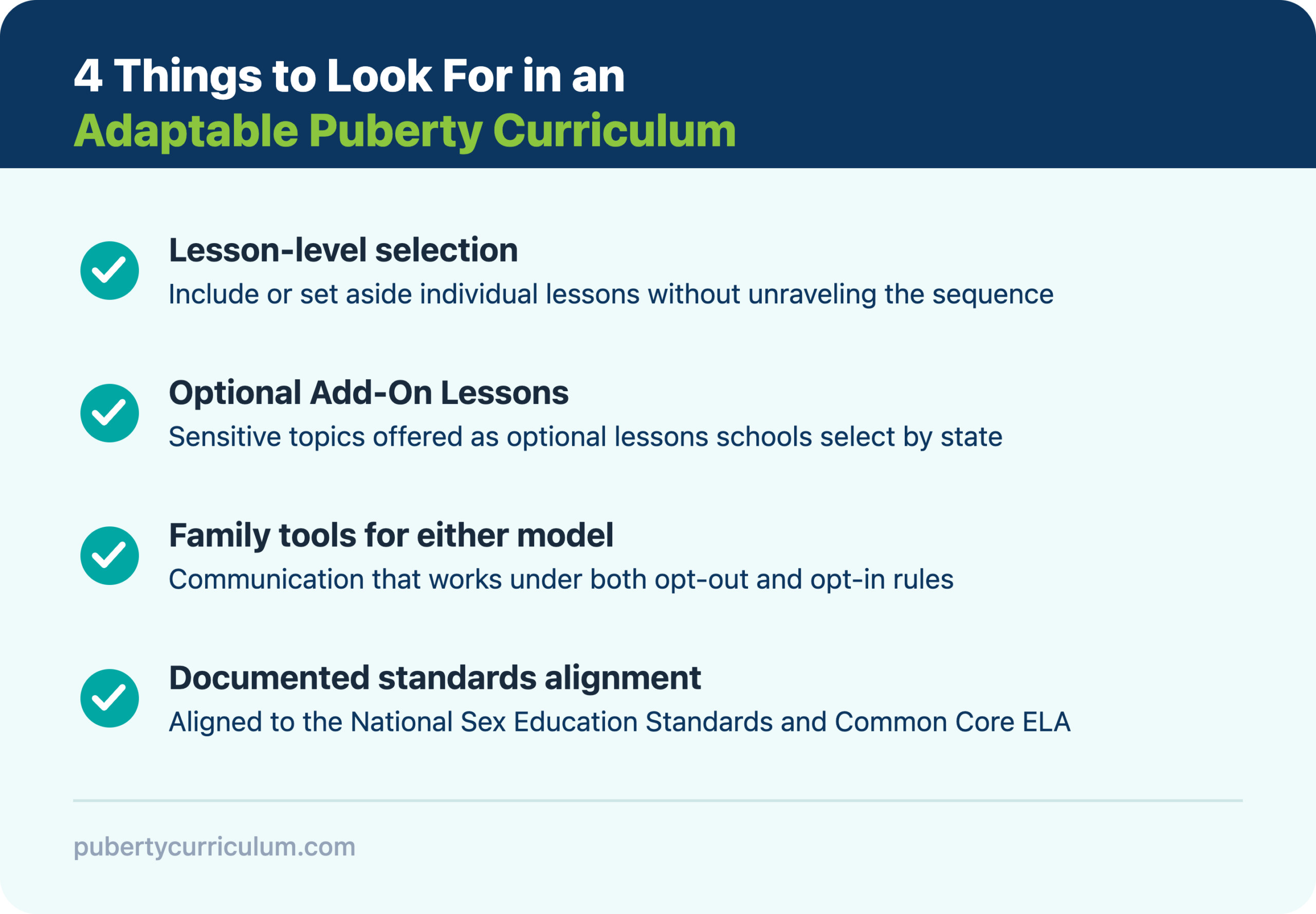
- Lesson-level selection. You can include or set aside individual lessons based on your state’s requirements, without unraveling the rest of the sequence.
- Optional add-on lessons for sensitive topics. Areas like gender and sexual orientation, contraception, and HIV and STIs are offered as optional lessons schools select based on state requirements, rather than forced into every implementation. Sexual abuse prevention content, which is widely mandated under laws such as Erin’s Law, should be available to districts that need it.
- Family engagement that works in either participation model. Look for transparent communication tools that perform well under opt-in rules, where proactive outreach is what earns parental consent. PWY’s family engagement tools are designed to function in both opt-out and opt-in environments.
- Standards alignment you can document. Alignment to the National Sex Education Standards and to Common Core ELA gives you defensible language for selection committees and helps justify instructional time.
Puberty: The Wonder Years was built around this kind of flexibility. Schools choose which lessons to teach and which optional Add-On Lessons to include, which lets the same curriculum serve a restrictive state and an expansive one without a separate edition for each.
Standards as a Quality Benchmark, Not a Compliance Shortcut
It helps to separate two questions that often get blurred. Does the curriculum comply with my state’s law? And is the curriculum good? Compliance is non-negotiable and specific to your state. Quality is portable, and standards are a useful proxy for it.
Because fewer than half of states require medical accuracy, a curriculum that is medically accurate by design gives you a quality floor the law may not guarantee. Comprehensive, skills-based sex education is endorsed by the American Academy of Pediatrics, the American Medical Association, and the Society for Adolescent Health and Medicine, and it is associated with healthier outcomes for students. Alignment to the National Sex Education Standards signals that the material reflects current, age-appropriate consensus.
Two questions, kept separate: Use standards alignment as a quality screen, then verify legal compliance separately against your state’s statutes. Treating NSES alignment as a quality benchmark rather than a compliance requirement keeps your evaluation honest, and it gives you cleaner answers when a board member asks why you chose this program over a cheaper one.
A Practical Way to Map a Curriculum to Your State
You can turn all of this into a repeatable process. Before you commit to any program, run these six steps.
- Confirm your mandate. Document what your state currently requires, what it prohibits, and whether participation is opt-in or opt-out. Verify against current statute, since this changes often.
- Separate must-teach from may-teach. List the topics you are required to cover and the topics you are permitted, but not required, to include.
- Map lessons to that list. Check whether the curriculum lets you cover every must-teach topic and gives you optional lessons for the may-teach topics, so you are never forced into topics you cannot use.
- Pressure-test participation. Confirm the family communication tools fit your participation model, especially if you operate under opt-in rules.
- Screen for quality. Verify medical accuracy and standards alignment, and look for a consistent instructional method. PWY’s Skills-Based Instruction follows a 4-step model, explain, model, practice, and apply, which makes fidelity straightforward to evaluate across classrooms.
- Document your rationale. Write down why the curriculum satisfies both compliance and quality. That record is what protects the decision later.
This process pairs well with a broader evaluation framework. If you are building a full rubric, our guide on how to evaluate and choose a puberty curriculum walks through the four factors that matter most.
Built to Travel Across State Lines
A patchwork of laws calls for a curriculum that was designed for variability, not one that assumes every district looks the same. Puberty: The Wonder Years focuses on grades 4-6, which is increasingly important as students begin puberty education in grade 4 rather than later. It pairs that focus with an adaptable structure, alignment to national standards, and a “Freedom To” philosophy that frames puberty positively, which tends to be easier to defend to families and boards than fear-based alternatives. The curriculum has been refined across more than two decades by a certified sexuality educator, so the flexibility comes with a track record behind it.
If you are weighing options against your state’s requirements, the most useful next step is to see the curriculum yourself. Request a free curriculum preview and review the lessons, the optional Add-On Lessons, and the family engagement tools against your own compliance and quality checklist. You will know within an afternoon whether it fits.