

Across national surveys, about 84% of parents support comprehensive sex education in schools. That figure has held steady across multiple polls of parents over the past several years. Yet most administrators, when asked about puberty education, do not describe a story of broad community support. They describe a small number of phone calls, a thread on a community Facebook page, and a board member asking pointed questions in a closed session.
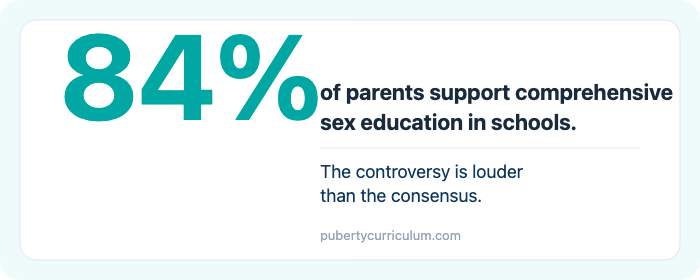
The controversy is louder than the consensus. That gap, not the curriculum content itself, is what most opt-out decisions and most parent complaints are actually about.
In our work with schools that teach puberty education without controversy, the difference is rarely the lessons. The difference is whether families experience the program as something done with them or something done to their children. Family engagement, when it is designed into a curriculum and supported by school leaders, is the lever that closes the gap between the quiet majority and the loud minority. It is also, in our experience, the most reliable way to reduce opt-outs over time.
The Real Reason Parents Opt Out (And It Is Not the Lessons)
When a parent opts a child out of puberty education, the reason they give in writing is rarely the reason they reach the decision. The decision often forms earlier, before the lesson plan is in front of them, in the moment they hear about the curriculum from someone other than the school.
Parents who oppose sex education almost universally describe a few common triggers. Parents who become engaged supporters describe a different set of experiences. The same neighborhoods, the same curriculum, the same school. The difference sits in how the school communicates.
Triggers of Opposition
- Hearing about the curriculum secondhand, often through social media
- Feeling excluded from the decision
- Encountering language or topics they did not expect
- Not being offered a meaningful choice
Triggers of Engagement
- Receiving a clear, warm letter from the school in advance
- Previewing lesson outlines before instruction begins
- Seeing a Family Activity Sheet come home with their child
- Feeling respected as the primary teacher of family values
The same parent population, the same neighborhood, the same curriculum. The difference is sequence, transparency, and tone.
Those three variables sit inside an administrator’s control. Curriculum content does not move much from district to district. Communication strategy does, and the difference shows up directly in opt-out rates.
What Family Engagement Infrastructure Actually Looks Like
A single parent night does not constitute a family engagement strategy. Strong programs are built on four predictable touchpoints that families come to expect.
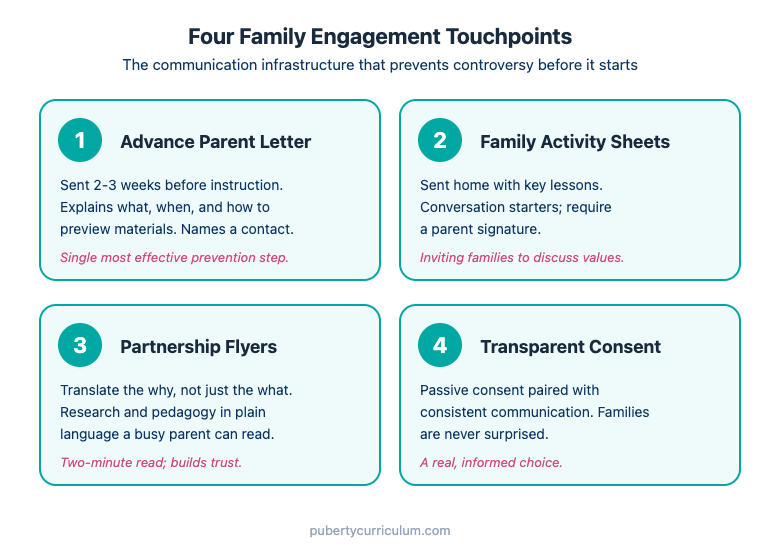
The first is a clear, advance parent letter that introduces the program before instruction begins. It names what will be taught, how it will be taught, and how families can preview materials or ask questions. The tone is informative, not defensive.
The second is signed Family Activity Sheets that come home with key lessons. These are short, structured conversation starters that ask the family to discuss a topic at home and return a signed acknowledgment. They serve two purposes at once: they keep families informed in real time, and they invite parents to discuss the topic through their own values rather than relying on the school to do it for them.
The third is Family Partnership Flyers that explain the why behind a unit, not just the what. These flyers translate research and pedagogy into language a busy parent can read in two minutes.
The fourth is a transparent consent process. PWY’s default is a passive consent model, where families are informed in advance and can opt their child out, paired with consistent communication so families never feel surprised. The materials adapt to opt-in states as well, so districts can comply with their state’s specific requirements. The point is not the consent mechanism itself; the point is that families know what is coming and feel they have a real choice.
| Touchpoint | Purpose | When It Lands |
|---|---|---|
| Advance parent letter | Inform families about the program and how to preview | 2-3 weeks before instruction |
| Family Activity Sheets | Invite home conversations using the family’s values | With key lessons throughout the unit |
| Family Partnership Flyers | Translate the why and the research behind the unit | At unit launch and major transitions |
| Transparent consent process | Give families a real, informed choice | Alongside the parent letter; updated annually |
Administrators evaluating a curriculum can audit it against this list. If the program leaves family communication entirely up to the teacher, that is a structural risk, not a feature. PWY’s family engagement tools are designed to be turnkey: the letters, flyers, and activity sheets are written and ready to send, so a district does not have to build the infrastructure from scratch.
The Home-School Partnership Philosophy
Behind the tools is a stance that shapes how schools talk about puberty education in the first place. PWY’s home-school partnership philosophy treats families as the primary sex educator for their children. The school’s role is to support that primary role with accurate information, age-appropriate framing, and shared language.
That stance is not a marketing slogan. It changes the script administrators use in board meetings, the tone teachers take in introduction letters, and the frame parents encounter when their child mentions a lesson at the dinner table. When the school’s stance is “we are partnering with you,” skeptical parents have a different conversation to engage in than “we are teaching this whether you like it or not.”
The “Freedom To” philosophy reinforces the same posture inside the classroom. Lessons celebrate growing up rather than scaring students about it: freedom to enjoy childhood, freedom to develop healthy relationships, freedom to make informed decisions. Parents who worry their child will be frightened or shamed encounter, instead, a tone they recognize from how they would want to talk with their child themselves.
A clear philosophical stance, named out loud, also gives administrators something to defend when the question comes from the board. “We honor families as the primary educator and partner with them through transparent communication” is a defensible position. “We are following state requirements” is a posture, not a partnership.
A 30-Day Family Engagement Plan for Administrators
If you are introducing or refreshing a puberty education program, three actions in the first 30 days do most of the work.
Day 1-7: Send the introduction letter early. Two to three weeks before instruction begins, families should already have a written explanation of what their child will learn, when, and how to preview materials. Include a named contact for questions. This is the single most effective controversy-prevention step a school can take.
Day 8-21: Host a low-pressure preview window. A walk-in evening, a brief lunch session, or a recorded overview that families can watch on their own time gives the small number of parents who want a closer look the chance to engage without making a public stand. Most parents will not attend. The point is not attendance; it is the offer.
Day 22-30: Send the first Family Activity Sheet home with the first lesson. Once families experience the curriculum as something that arrives at their kitchen table with a question to discuss, the framing shifts. The school is no longer the place a topic happens. The home is.
These three actions do not require a new budget line. They require an administrator’s calendar attention for a few hours during the rollout window.
What to Expect Over Two and Three Years
Family engagement compounds. The first year is the political risk window: it is when families form their lasting impressions of the program, when the loudest voices test whether the school will hold its position, and when the communication infrastructure is being built into the school’s habits.
By the second and third year, the pattern shifts. Schools that maintain consistent, transparent communication typically see opt-outs decline, not rise. Parents who opted out in year one often allow their child to participate in year two after hearing from neighbors. Teachers report fewer “Why didn’t anyone tell us?” calls because families now expect the letter, the activity sheet, and the partnership flyer. Administrators stop bracing for the topic and start treating it as a standard unit on the calendar.
That trajectory is what 84% parent support actually looks like at a district level. It does not arrive as a press release. It arrives as the slow normalization of a program families came to trust because the school invited them in early and kept them in.
If you would like to see what a Family Activity Sheet, a Family Partnership Flyer, and a parent introduction letter look like in practice, request a free curriculum preview. The preview includes the family-facing materials so you can audit them against your own communication standards before you adopt anything.