

Ask a room of fifth graders when puberty starts, and you will get a dozen answers, because a dozen different bodies are keeping a dozen different schedules. Some students in that room finished a growth spurt last year. Others will not begin for another two. This is the quiet problem at the center of how schools plan puberty education: we tend to teach it as a single event, on a single date, to students whose development is anything but synchronized.
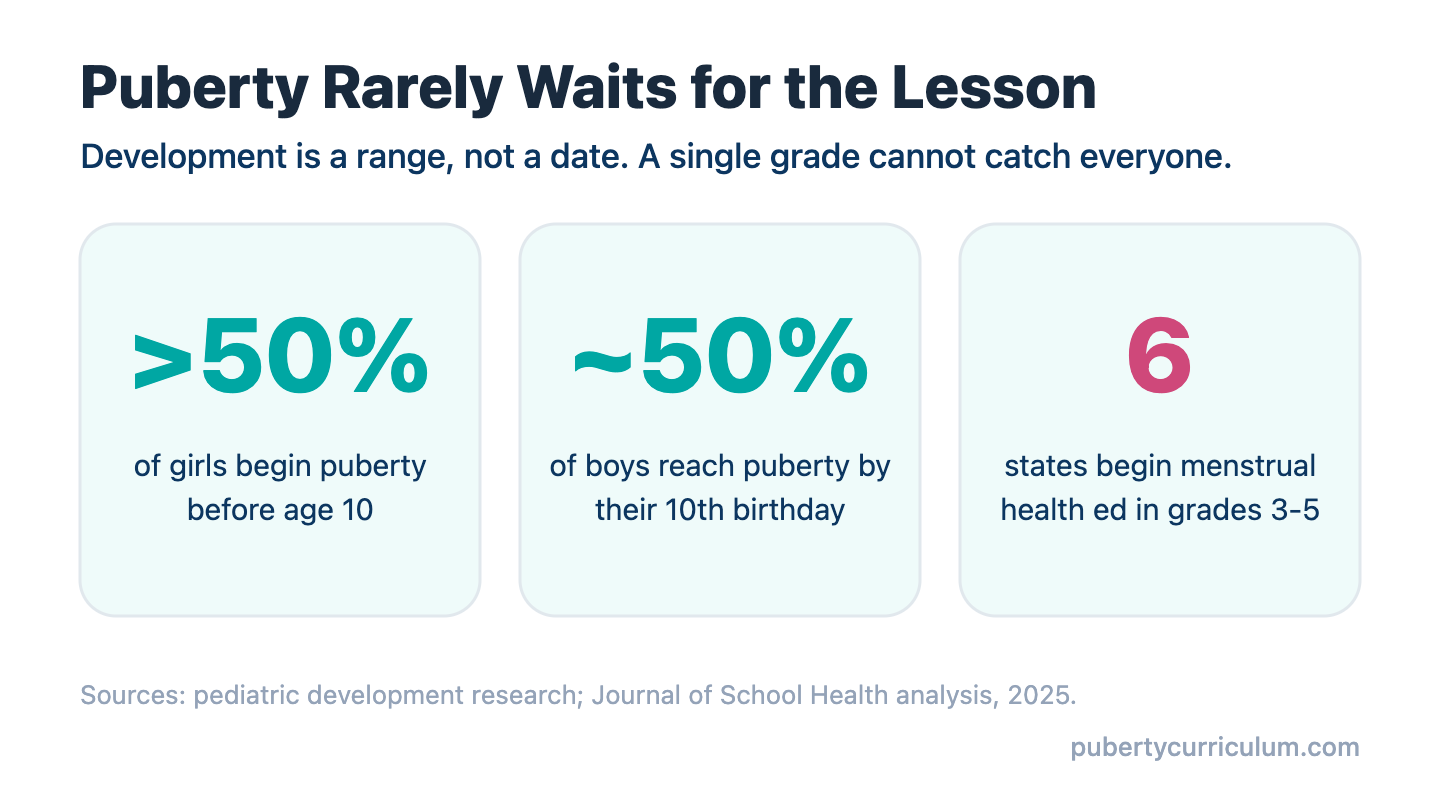
Research keeps widening that gap. Over half of girls now begin puberty before age 10, and nearly half of boys reach puberty by their tenth birthday. Early signs such as breast development are appearing about a year earlier than they did a few decades ago. A 2025 analysis in the Journal of School Health found that only six states begin menstrual health education in grades 3 through 5, while seven states wait until grades 6 through 8. For many students, in other words, the first lesson arrives after the first period.
If you are evaluating a puberty curriculum, the timing question is really a design question. The strongest programs answer it the same way: not with a better single lesson, but with a deliberate progression across grades 4, 5, and 6. Here is why that structure matters, and how to recognize it when you see it.
Puberty Does Not Arrive on a Schedule
Any grade you pick for a one-time puberty unit will be wrong for a large share of your students. Teach it late in fifth grade, the traditional choice, and you reach the early developers months or years after they needed the information. Push it to sixth, and you widen that gap. Move it earlier without a plan to revisit it, and you deliver content to nine-year-olds that many will not need to act on for two more years, by which point the details have faded.
There is no grade that catches everyone at the right moment, because puberty is a range, not a date. That is the case for beginning earlier, and it is also the reason we argue that puberty education should start in Grade 4. Starting early gives every student a foundation before their body changes. Starting early and then returning to the material each year is what actually meets students where they are, one developmental stage at a time.
Why a Single Lesson Cannot Do the Job
Even setting timing aside, a one-time talk asks too much of a single exposure. It assumes that hearing information once is the same as learning it, and that learning it is the same as being able to use it. Neither assumption holds.
We build Puberty: The Wonder Years on an adapted Health Belief Model, a behavioral science framework identifying four factors that have to be present before a young person develops healthy behavior: knowledge, self-efficacy, skills, and environmental support. Knowledge is only the first factor. As we have written before, knowledge alone does not change behavior. Self-efficacy and skills are built through practice, not through a single presentation.
The four factors of the Health Belief Model: healthy behavior takes hold when a student has knowledge, self-efficacy, skills, and environmental support. A single lesson can deliver knowledge. The other three are built through repetition, practice, and reinforcement over time, which is precisely what a multi-year design provides.
That is where Skills-Based Instruction comes in. Every skill in the curriculum is taught through a consistent four-step process: explain and motivate, model and demonstrate, practice with feedback, and apply to real-life situations. A skill like assertive communication or refusal cannot move from step one to step four in an afternoon. Students need to practice it, revisit it, and apply it in progressively more realistic situations as their social world grows more complex. One lesson can start that work. It cannot finish it.
What a Spiral Curriculum Actually Looks Like
A spiral curriculum introduces a concept at an age-appropriate level, then returns to it in later grades with added depth and complexity. Concepts are not taught once and abandoned. They are planted, revisited, and grown. Across grades 4 through 6, that progression moves from foundation to deepening to application.
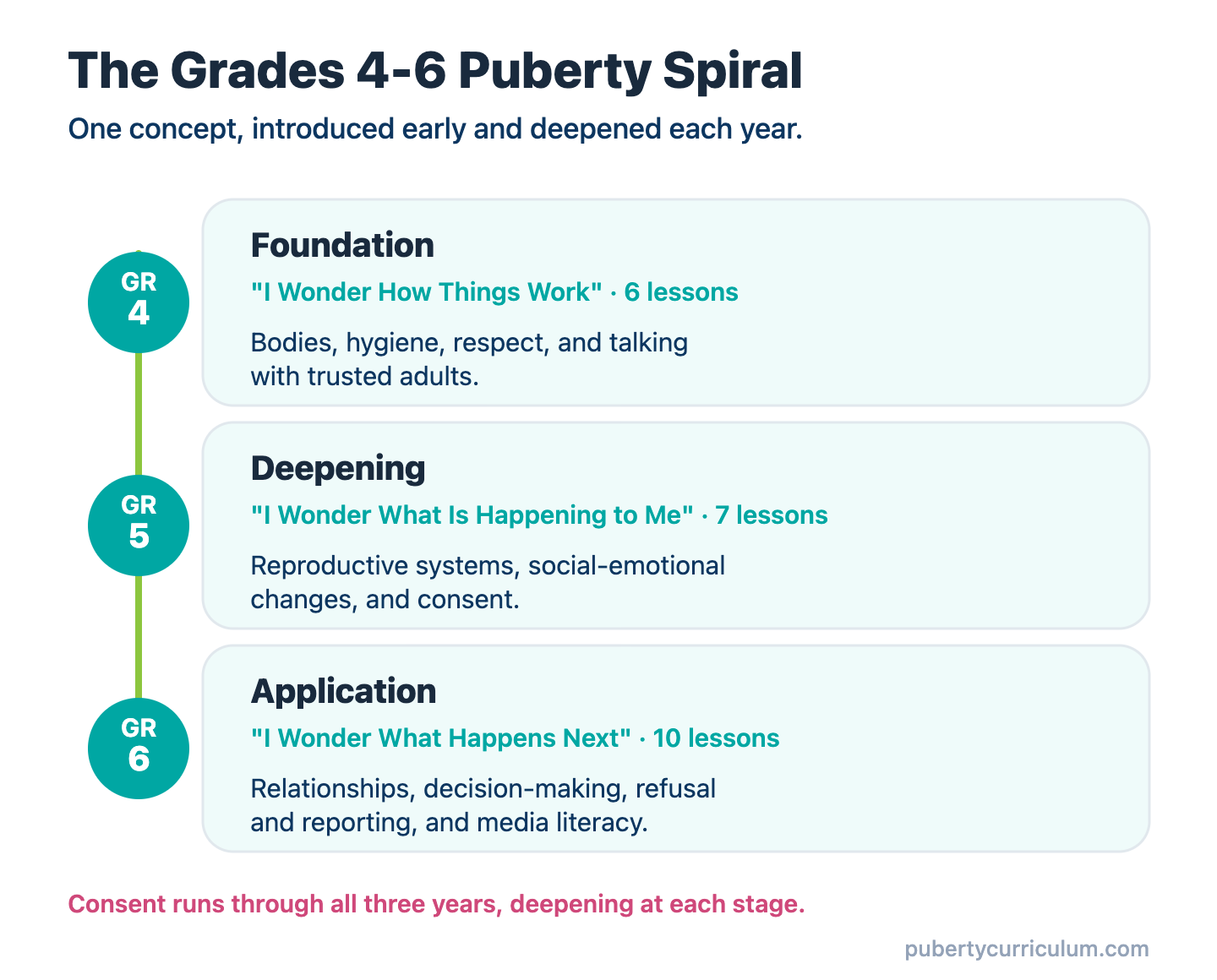
Consent is a clear example of the spiral at work. The same word appears in all three years, but the depth is different every time, because the student is different every time.
| Grade | How consent shows up |
|---|---|
| Grade 4 | Students practice respectful communication and learn to bring questions to trusted adults. |
| Grade 5 | Consent becomes an explicit focus: boundaries, bodily autonomy, and recognizing when a boundary has been crossed. |
| Grade 6 | Consent lives inside the study of healthy relationships, paired with refusal and reporting skills practiced through role play. |
Repetition Is a Feature, Not Redundancy
Selection committees sometimes look at a spiral and worry about overlap. If grade 6 revisits topics from grade 4, are we paying for the same lesson twice? The answer is no, and understanding why is central to evaluating any strong program.
Repetition across a spiral is intentional. Because students develop on their own timelines, they assimilate the same concept differently each year. A child who was not yet experiencing puberty in grade 4 engages with the material very differently in grade 5, when it has become personal. Returning to a topic is not a redundancy to trim. It is the mechanism that turns exposure into retention, and awareness into skill.
Returning to a topic is not a redundancy to trim. It is the mechanism that turns exposure into skill.
This is also how a spiral reinforces all four factors of the Health Belief Model over time. Each pass adds knowledge, but it also builds self-efficacy through repeated practice, strengthens skills through application, and, through family engagement tools that travel home each year, sustains the environmental support that helps new behavior stick.
How the Spiral Makes Evaluation Easier
A well-built spiral is not only better for students. It is easier for you to evaluate, defend, and monitor, which matters when a selection committee, a board, or a parent asks you to justify the choice.
Consistency is the reason. When every lesson across all three grades follows the same architecture, and every skill follows the same four-step model, fidelity becomes observable. You can walk into any classroom in any grade and see whether the instruction matches the design. Assessment is built to match that structure, with pre and post tests at each grade level and implementation logs that document what was taught and when. Instead of trying to measure a single event, you are measuring a documented progression with data points at every stage. That is a far stronger position to be in when you need to show a board that the program works.
What to Look For When You Evaluate
When you compare puberty curricula, the structure of the program tells you as much as the topic list. The difference between a genuine spiral and a single-grade unit with extra materials bolted on shows up quickly once you know what to look for.
A true spiral
- Documented scope and sequence across grades 4 through 6
- Concepts visibly deepen each year
- Built on a named behavioral framework
- Consistent, observable lesson architecture
- Family engagement at every stage
A single-grade unit
- One standalone unit, often late in fifth grade
- Topics taught once, then dropped
- Information-only, with few practiced skills
- Inconsistent structure, hard to observe
- Family contact at kickoff, if at all
Turned into questions you can bring to any evaluation, that becomes a short checklist:
- Does it span multiple grades by design? Look for a documented scope and sequence across at least grades 4 through 6, not a standalone unit with optional add-ons.
- Do concepts deepen, or just repeat? Trace one topic, such as consent, from the earliest grade to the latest. The depth should visibly increase.
- Is it built on a named framework? A defensible program can point to a behavioral science model, such as the Health Belief Model, and a consistent instructional method, such as a four-step skills model.
- Can you observe and measure fidelity? Consistent lesson architecture and per-grade assessment make evaluation straightforward rather than subjective.
- Does it engage families at every stage? Environmental support is one of the four factors, and it should show up across all three years, not just at kickoff.
A curriculum that answers these questions well is one you can stand behind. Our full guide to evaluating and choosing a puberty curriculum walks through the rest of the checklist.
Meet Students Across the Years, Not in a Single Afternoon
Puberty education works when it meets students across the years their bodies are actually changing, not in a single afternoon chosen for the calendar’s convenience. A spiral across grades 4, 5, and 6 is how you get there.
If you want to see what that progression looks like lesson by lesson, you can request a free preview of Puberty: The Wonder Years and review the full grades 4 through 6 scope and sequence for yourself.