
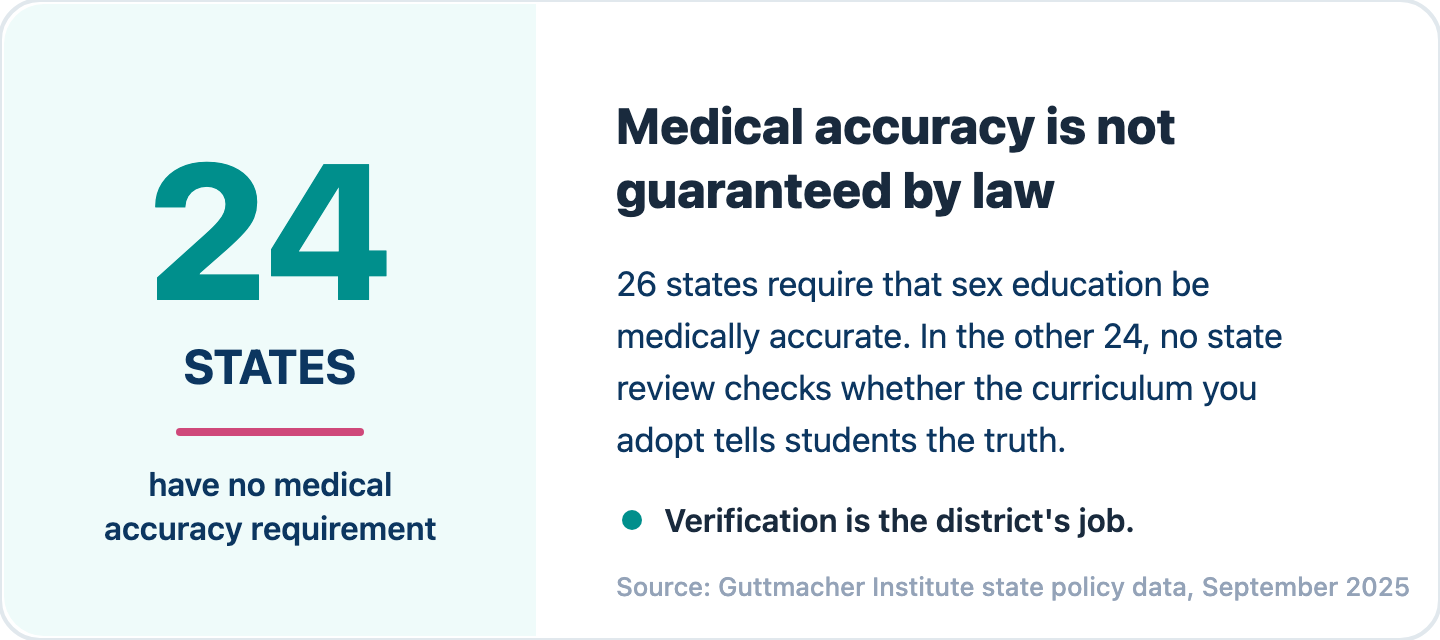
Twenty-six states require that sex education be medically accurate, according to Guttmacher Institute policy tracking. Twenty-four do not. If your district sits in that second group, no state review will check whether the curriculum you adopt tells students the truth. The review that catches an error is the one you run yourself.
Most evaluation rubrics treat medical accuracy as a yes-or-no line item. A publisher says their materials are accurate, the box gets checked, and the committee moves on to cost and teacher support. In our work with schools, that line item is where the most expensive mistakes hide, because accuracy in puberty education is several properties at once, each failing differently.
Medical Accuracy Has a Shelf Life
Accuracy in a puberty curriculum degrades if nobody maintains it. Research on pubertal timing has shifted in the last two decades, and terminology that read as standard in 2010 sounds dated to a fifth grader now. So the question is not only whether the material is accurate today, but whether the publisher keeps it accurate. A curriculum revised once in fifteen years may have been correct when written and drifted since.
Puberty: The Wonder Years was first published in 2002 and revised in 2005, 2007, 2010, 2015, 2017, 2021, 2022, and 2023. That cadence carries more information than any accuracy claim on a product page, and because the Teacher Resources are digital, corrections reach an active subscription without repurchasing.
Ask for this: The revision history and the reason behind the most recent update. A publisher who cannot produce one has answered the question.
What Accuracy Looks Like in Grades 4 Through 6
Medical accuracy in this age band shows up in three specific places, and none of them require a clinician on your committee to assess.
Anatomical naming
The American Academy of Pediatrics recommends teaching children the correct anatomical names for their body parts, as do evidence-based abuse prevention programs. A child who has the words is better positioned to describe what happened and be understood by an adult who can act, and euphemisms imply these parts of the body are shameful. Substituting invented names is a decision with safety implications, not a stylistic one.
Timing described as a range
Puberty does not run on a schedule, and it arrives earlier than it used to. A 2020 JAMA Pediatrics meta-analysis by Eckert-Lind and colleagues found the average age at first breast development in girls fell by roughly three months per decade between 1977 and 2013. In boys, Herman-Giddens and colleagues, studying more than 4,000 boys across 41 states for Pediatrics in 2012, found average ages at the first stage of genital development, which begins with testicular enlargement, between about 9.1 and 10.1 years, with population averages differing by race and ethnicity, six months to two years earlier than previous studies recorded.
Two clarifications matter, and a good curriculum makes both. The first visible signs of puberty are not menstruation; the average age at first period has shifted far less, and conflating the two alarms families unnecessarily. And earlier average onset does not mean no timing raises a question, since development before roughly age 8 in girls or age 9 in boys, or no breast development by about 13 or testicular growth by about 14, generally warrants a clinician’s input. Presenting one age as the norm teaches students something is wrong with them when their own development arrives early or late.
This is also where a single-lesson program quietly fails, describing a multi-year range accurately while delivering everything in one grade. PWY spirals across grades 4, 5, and 6 to meet students at different points in their own development.
Variation framed as ordinary
Intersex variations, meaning differences in reproductive or sexual anatomy present at birth, are well documented, though prevalence estimates range widely by definition, from well under 0.1 percent under narrow clinical criteria to roughly 1.7 percent under the broader definition used by Blackless and colleagues in 2000. An accurate curriculum acknowledges the variation without overstating any single number.
PWY teaches through a “pattern, not rule” framework, presenting common patterns while making clear that some people do not fit them, and uses terms such as “male-bodied people” and “female-bodied people” alongside traditional ones. That is one defensible approach among several in current practice, and its merit is keeping anatomy and identity distinct, a precision choice rather than a political one.
The Three Places Accuracy Breaks Down
Inaccurate instruction rarely comes from a publisher deliberately printing something false. In our work with schools, it comes from three predictable failure modes:
| Failure mode | What it looks like in class | What to check |
|---|---|---|
| Stale materials | Terminology and statistics that predate the students in the room | Revision history and date of the last update |
| Fear-based framing | Risk exaggerated to discourage behavior; worst cases shown as typical | Whether consequences are stated in proportion |
| Improvised answers | A teacher caught off guard, filling the gap from memory | Whether prepared answers exist for common questions |
The third is the most common and least discussed. Teachers consistently report that what they fear most is being asked something they cannot answer.
A teacher who is caught off guard will answer anyway, and whatever they say becomes the curriculum for that classroom that year.
PWY addresses this structurally through the Question Box methodology. Every student writes a question or comment at the end of every lesson, which protects the anonymity of students who have real questions. Teachers prepare responses between lessons using Appendices supplying more than 30 sample questions with model answers, then deliver them at the start of the next lesson. Nobody improvises.
Fear-based framing is subtler, because overstating risk is a factual error even when the underlying topic is real. PWY works from a “Freedom To” philosophy, framing puberty education around freedom to enjoy childhood, develop healthy relationships, reach goals, and make informed decisions. Its trauma-informed design carries that into the classroom through content warnings, exit options, and a standing rule against shaming or scare tactics. We have written before about why fear-based framing works against you.
Accurate Information Is Only Half the Job
A curriculum can be flawless on the facts and still leave students unprepared.
Kirby’s 2007 review of effective sex and STD/HIV education programs, and decades of evaluation research since, point in a consistent direction: knowledge alone does not change behavior. Students can score well on an anatomy post-test and still be unable to refuse a situation that makes them uncomfortable, or unsure which adult to tell.
PWY is built on an adapted Health Belief Model targeting four factors in every lesson: knowledge, self-efficacy, skills, and environmental support. Medical accuracy lives in the first. The other three determine whether accurate information becomes useful to a student, a gap we covered in our piece on why knowledge alone does not change behavior.
Ask about the facts
- Are anatomical terms used correctly?
- Is development described as a range?
- Are statistics current and attributed?
- Is risk stated in proportion?
Ask about the practice
- Do students practice the skill, or only hear about it?
- Is there feedback built into the lesson?
- Are skills applied to realistic situations?
- How would you know whether students learned it?
For evaluation, that means asking two questions instead of one. Is the information correct, and does the curriculum give students structured practice applying it? PWY teaches every skill through Skills-Based Instruction, a four-step process: explain and motivate the skill, model and demonstrate it, practice with feedback, then apply it to real-life situations. That structure makes fidelity observable in a classroom visit, and pre- and post-tests, rubrics, and implementation logs let you check whether the information landed.
Five Questions That Verify Medical Accuracy Before You Adopt
You do not need a physician on your selection committee, only five questions and a willingness to ask for documentation. These work against any curriculum.
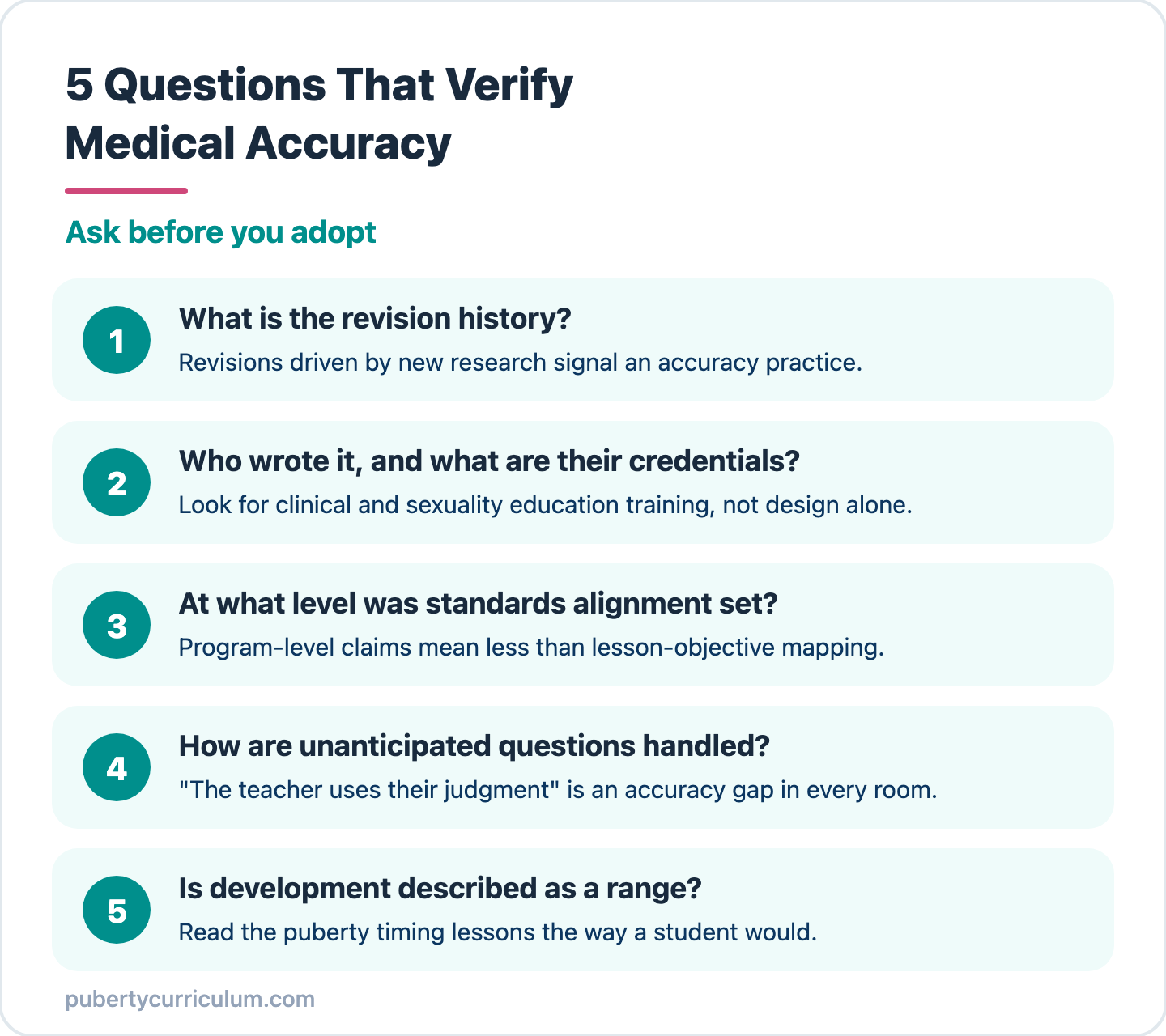
- What is the revision history, and what prompted the most recent revision? Revisions driven by new research and classroom feedback signal an accuracy practice. Revisions on a marketing schedule do not.
- Who wrote it, and what are their credentials? Look for clinical and sexuality education training, not instructional design alone.
- What standards is it mapped to, and at what level was alignment determined? Alignment claimed for a whole program means less than alignment mapped to lesson objectives.
- How does it handle questions the lesson did not anticipate? If the answer is that the teacher uses their judgment, you have found an accuracy gap that will open in every classroom.
- Does it describe development as a range? Open the puberty timing lessons and read them the way a student would.
It also helps to ask whether the approach is one major medical bodies recognize. The American Academy of Pediatrics, the American Medical Association, and the Society for Adolescent Health and Medicine have all endorsed comprehensive, inclusive sex education, giving a committee external footing if a choice is questioned.
For reference, PWY was written by Wendy L. Sellers, RN, MA, CSE, FASHA, an AASECT Certified Sexuality Educator and Trainer. It is mapped to the National Sex Education Standards (2nd edition, 2020), National Health Education Standards, Common Core English Language Arts, Search Institute’s 40 Developmental Assets, Kirby’s 17 Characteristics, and the CASEL framework in grade 6.
Then ask for a preview and check these yourself. Our broader guide to how you evaluate a puberty curriculum covers the dimensions alongside accuracy.
When Your State Requires Something You Question
Some districts face a harder version. A few states now require specific materials that medical organizations have publicly criticized on accuracy grounds. Tennessee’s 2024 Meet Baby Olivia Act, requiring public schools to show a three-minute animated fetal development video produced by an advocacy group, drew that objection over how the video dates fetal development. Similar bills have been introduced elsewhere.
Districts in that position have a narrower problem than it first appears. They can meet a specific requirement while holding the rest of the program to a higher standard, which requires a curriculum built to be adapted. PWY lets schools select which lessons and optional Add-On Lessons to include based on state requirements, so a mandate touching one topic does not compromise the rest of the sequence.
Before you adopt: Laws here change quickly, so verify your state’s current requirements and revisit them each cycle. Our guide to choosing a curriculum that fits your state’s requirements walks through the mapping process.
Accuracy Is How Trust Holds
A 2022 Journal of Adolescent Health meta-analysis pooling 23 surveys found that 90 percent of parents support sexual health education in schools. That support rests on the belief that what their children are taught is true. Every parent or trusted adult reading a Family Activity Sheet at the kitchen table, in English or Spanish, is running a small accuracy review, and the district’s credibility rides on the result.
Five questions, a revision history, and two lessons read closely will tell you most of what you need to know.
If you want to run those questions against a real curriculum, request a free 60-day preview of Puberty: The Wonder Years and read the lessons yourself.