

Walk into a sixth grade classroom in October and the range is hard to miss. One student has grown four inches since spring. Another still looks like a fourth grader and knows it. Someone in the back row is navigating a first crush, someone else is managing a period during passing time, and nearly all of them are carrying questions they would rather not ask out loud.
By sixth grade, puberty has moved from the horizon into the room. That single fact should shape everything about what 6th grade puberty education covers, how it is taught, and what it asks of students. In our work with schools, we have seen districts invest real thought in when to introduce puberty education and then treat the final year as a repeat of the year before. Sixth graders notice. Their needs have moved, and the curriculum has to move with them.
The 6th Grade Classroom Is Not the 4th Grade Classroom
The developmental math is straightforward. Research shows more than half of girls now begin puberty before age 10, and nearly half of boys begin puberty by their 10th birthday. We covered that shift in depth in Puberty Is Starting Earlier. Are Schools Keeping Up? Set those numbers against the typical age ranges described by the American Academy of Pediatrics and the conclusion is clear: a typical 11- or 12-year-old sixth grader is well into the process, not waiting for it to start.
The changes are not only physical. Sixth graders are developing the cognitive capacity to reason about consequences, weigh risks, and think about who they want to become. Their social world is intensifying at the same time: friendships are shifting, romantic interest is emerging for some, and peer influence is climbing toward its adolescent peak. Instruction that stops at “here is what will happen to your body” misses where these students actually are.
There is a practical implication for anyone evaluating a curriculum. Grade 6 lessons should speak to students in the middle of puberty, addressing emotional and social changes, cognitive development, and the decisions that are starting to feel real. If the final year of your program reads like an introduction, it was written for a different classroom.
From Understanding Changes to Applying Skills
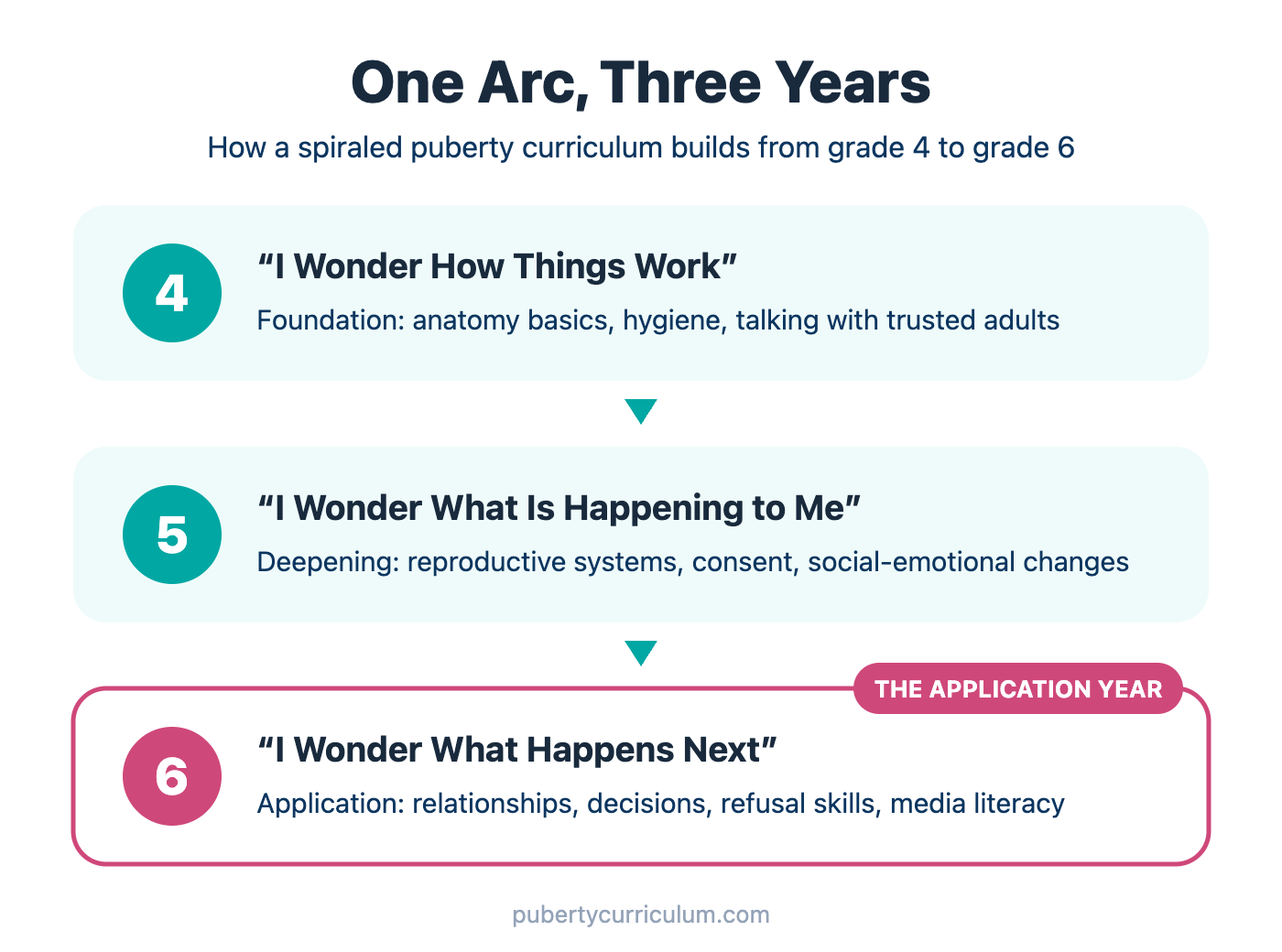
The strongest programs treat grades 4 through 6 as one arc rather than three disconnected units. We have written before about teaching puberty across grades 4, 5, and 6, and the logic matters most in the final year. Grade 4 builds the foundation: basic anatomy, hygiene, and the habit of talking with trusted adults. Grade 5 deepens the picture as changes accelerate. Grade 6 is the application year, where students take what they know and practice using it in situations that mirror real life.
In Puberty: The Wonder Years, the grade level subtitles tell the story. Grade 4 is “I Wonder How Things Work.” Grade 5 is “I Wonder What Is Happening to Me.” Grade 6 is “I Wonder What Happens Next.” The shift from understanding to application is deliberate, and it reflects the adapted Health Belief Model that underpins the curriculum: healthy behavior requires knowledge, self-efficacy (a student’s confidence in their ability to act), skills, and environmental support. Every lesson targets all four factors, and the application year gives the skills factor the most room to grow.
Some repetition across grades is intentional, because students develop on their own timelines and absorb the same concepts differently each year. The evaluation question for grade 6 is not “is anything repeated” but “does this year ask students to apply what they know.”
What a Strong 6th Grade Curriculum Covers
When curriculum directors ask us what belongs in the final year, we point to the National Sex Education Standards as the benchmark and to a consistent set of topic areas:
Healthy relationships. Sixth graders are beginning to distinguish friendships from romantic relationships. They need concrete tools for recognizing healthy and unhealthy patterns in both.
Consent and boundaries. Building on the dedicated consent work many programs introduce in grade 5, sixth graders are ready for the elements of consent in everyday contexts: asking permission, listening to the answer, and respecting the response.
Communication. Students at this age can learn to recognize passive, aggressive, and assertive communication and practice the assertive style that healthy relationships require.
Responsible decision-making. A structured decision-making model gives students a repeatable way to evaluate choices, consider consequences, and identify the benefits of waiting.
Sexual health. Aligned to national standards, grade 6 is where students learn age-appropriate facts about reproduction and sexually transmitted infections, including how infections are prevented, tested for, and treated.
Refusal and reporting skills. Sixth graders need practiced strategies for refusing unsafe situations and reporting interpersonal violence, not just encouragement to “speak up.”
Media and information literacy. Students this age are already online. They need a structured way to evaluate the accuracy and credibility of what they find there about bodies, relationships, and sex.
Future planning. The year should end with students connecting today’s decisions to the people they want to become.

If your current program covers half of this list, your sixth graders are getting half a final year.
Skills, Not Just Information
A topic list is necessary but not sufficient, because knowledge alone doesn’t change behavior. The more useful evaluation question is how a curriculum teaches.
PWY approaches every skill through Skills-Based Instruction, a 4-step model: the teacher explains and motivates, models the skill, students practice with feedback, and then apply it to realistic situations. This matters most in grade 6, where the skills carry real weight.
Why practice context matters: Research on refusal skills shows they do not transfer across contexts unless students practice them in the relevant context. A student who has rehearsed refusing a dare to jaywalk has not rehearsed the situation that matters. Role play in age-appropriate, relevant scenarios is what turns awareness into ability.
This is also why puberty education should start in grade 4 rather than compressing everything into a single year. Skills built over three years, each practiced at the right developmental moment, hold up better than a one-time unit delivered after puberty has already arrived.
Social-Emotional Learning Belongs in This Year
Many districts now expect social-emotional learning across subjects, and grade 6 puberty education is one of the most natural places for it. The content demands self-awareness, self-management, social awareness, relationship skills, and responsible decision-making, which are the five competencies of the CASEL framework.
| CASEL Competency | Where It Lives in Grade 6 Puberty Education |
|---|---|
| Self-awareness | Understanding the physical, emotional, and cognitive changes of adolescence |
| Self-management | Emotional regulation as hormones and brain development shift |
| Social awareness | Respecting differences in development, identity, and family |
| Relationship skills | Assertive communication, boundaries, and healthy friendship patterns |
| Responsible decision-making | A structured model for weighing choices and consequences |
PWY’s Grade 6 integrates the CASEL Social-Emotional Learning Framework explicitly, weaving those competencies through lessons on brain development, emotional regulation, healthy relationships, and future planning. Students learn why the changes of adolescence affect emotions and decisions, then practice the interpersonal skills that help them respond well.
For administrators and curriculum directors, this is a dual-purpose argument worth making to any selection committee: one set of lessons serves both health education requirements and SEL goals, which strengthens the case for instructional time.
Harder Questions Need Stronger Supports
Sixth grade questions are harder than fourth grade questions. That is true for students, who may be asking about things they have seen online, and for teachers, who worry about answering well.
This is where systematic supports earn their place. The Question Box methodology has every student write a question or comment at the end of every lesson, protecting the anonymity of those with real questions. Teachers review submissions between lessons and prepare answers using more than 30 model responses to the most common and most sensitive questions students ask. No one is put on the spot, and every question gets a thoughtful answer.
Trauma-informed design matters more in grade 6 as well. Content warnings before sensitive topics, guidance for handling emotional reactions, and exit options for students ensure that lessons on difficult subjects stay safe for everyone in the room, including students whose experiences the teacher may not know about.
When you evaluate a grade 6 program, look past the topic list to the support system around it. The question is not only whether hard topics are covered but whether teachers and students are equipped for the conversations those topics create.
Finish the Arc Well
Sixth grade is the year puberty education either becomes useful or becomes a rerun.
Students who leave the final year with practiced communication, decision-making, and refusal skills, plus the habit of seeking accurate information and trusted adults, are prepared for adolescence in a way no single unit can accomplish.
If you are deciding what your sixth graders will learn this year, the fastest way to judge a curriculum is to read it. You can preview Puberty: The Wonder Years and see how the Grade 6 lessons handle relationships, decision-making, media literacy, and the questions sixth graders actually ask.