

Ask any grade 4-6 teacher preparing to teach puberty education what scares them most, and the answer is rarely the content itself. It is the unscripted moment. A hand goes up. A student asks something unexpected. The room waits.
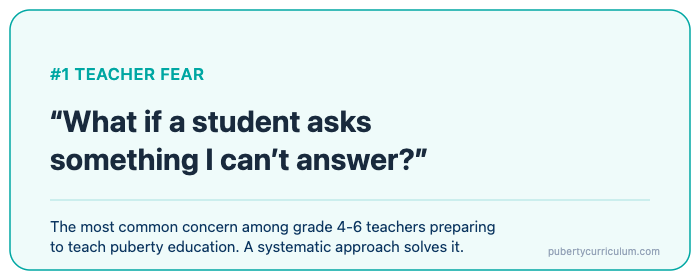
“What if a student asks me something I can’t answer?” is the question teachers name first in their own words, well ahead of concerns about parent pushback or politically charged topics. The fear is reasonable. Nobody wants to freeze in front of a class of ten-year-olds, and nobody wants to improvise an answer about bodies, relationships, or online content and then worry for the rest of the week whether a parent will hear about it.
The good news is that this problem has a systematic answer, not a personal-composure answer. You do not need to be quicker on your feet, more experienced, or more comfortable with the subject. You need a process that moves the hardest moments out of real time and into prepared time. That process is called the Question Box methodology, and it is one of the most practical structures in puberty education.
The question teachers fear most
In our work with schools, teacher anxiety about answering student questions is the single most consistent theme. It shows up in new teachers and twenty-year veterans, in health specialists and fifth-grade generalists who inherited the unit because nobody else wanted it. The fear is not really about knowledge. Many of the teachers who worry most are the ones who know the content well. The fear is about the performance: speaking clearly, kindly, and correctly in the seconds after a question lands.
When teachers feel this pressure, two things usually happen. Either they avoid topics that might invite hard questions, which narrows the lesson and leaves students underserved. Or they power through and answer in the moment, sometimes well, sometimes not, and then spend the rest of the day replaying what they said. Neither pattern is good for students, and neither is sustainable for teachers.
Why most anonymous question approaches fall short
Most teachers have tried some version of an anonymous question system. A jar on the desk. A folded-paper drop at the end of class. A digital form for older students. These tools help, but they are not a methodology. A jar by itself solves one problem (anonymity for the student who is willing to write) and leaves three problems untouched.
What a jar alone does
- Offers anonymity for willing writers
What a jar alone misses
- Time for teachers to prepare a good answer
- Universal participation, so real questions are hidden
- Consistency across lessons
- A reference for questions students actually ask at this age
A real system has to solve all four problems. That is what the Question Box methodology is designed to do.
How the Question Box methodology actually works
The Question Box methodology is a four-step loop that runs across every lesson in the unit. It is not a one-time activity or a fallback for emergencies. It is the structural backbone that holds the unit together.
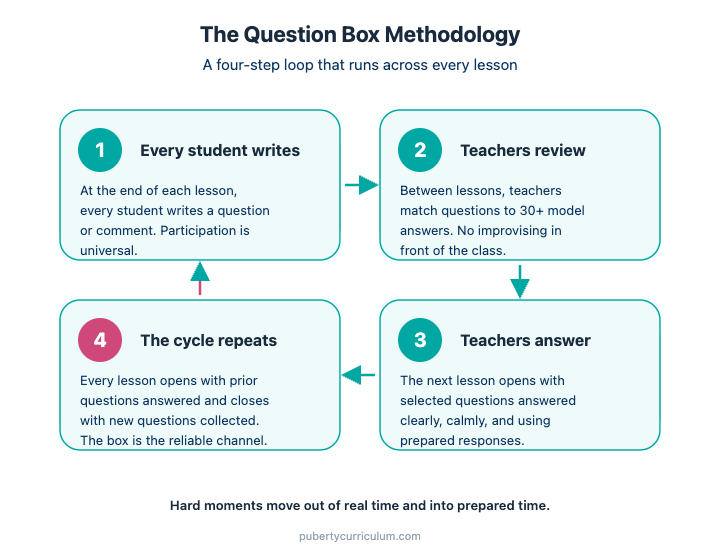
- Every student writes every lesson. At the end of each lesson, every student writes something, a question or a comment, and places it in the box. No student has to have a real question. Participation is universal.
- Teachers review between lessons. Before the next class, the teacher reads what students wrote. The curriculum’s Appendices include more than thirty sample questions with model answers across the most common and most sensitive topics students ask at grades 4-6, so teachers can match questions to prepared responses rather than writing from scratch.
- Teachers answer at the top of the next lesson. Selected questions are answered at the beginning of the following class, using the prepared responses as a guide. Students see that their questions are taken seriously and answered honestly.
- The cycle repeats. Every lesson opens with prior questions answered and closes with new questions collected. Students learn that the box is the reliable channel, not an exception.
The four steps work together. Remove any one of them and the system breaks down.
What changes when every student writes every lesson
Universal participation is the quiet key. If only students with real questions write, then writing is a signal, and the most self-conscious student, the one most likely to have a genuine question, is the least likely to use the system. When everyone writes, real questions disappear into the normal noise of the class.
The instructional authority that felt impossible to summon in the heat of the moment becomes available because you are not in the heat of the moment.
The effect on the teacher is just as important. You are no longer responding to a student in front of twenty-five peers. You are reading and preparing in a quiet moment, with time to check a reference, consult a colleague, or decide that a particular question needs a one-on-one follow-up with a school counselor instead of a class-wide answer.
This is a small shift in mechanics and a large shift in experience.
Building the Question Box into your classroom rhythm
You can start building this rhythm before you adopt a full curriculum. Four things help.
First, make the box itself unremarkable. A plain container on a shelf, used every lesson, becomes invisible. A decorated novelty box draws attention to the act of writing. Unremarkable is the goal.
Second, use a consistent prompt. “Write a question or a comment about today’s lesson.” That is it. Not “write a question if you have one.” The phrasing tells every student there is something to write, and students who would otherwise sit out will produce comments (“I already knew this” or “the video was too long”) that keep them engaged without requiring them to share something personal.
Third, protect the preparation window. Answering well between lessons requires time. Even fifteen minutes with a reference document and a colleague covers most of what comes in. If you are using a curriculum with prepared sample questions and answers, this step is faster. If you are not, identify a short list of trusted sources and stick to them.
Fourth, keep answers brief and consistent. Students do not need a lecture in response to each question. A clear, calm, two-to-three-sentence answer, delivered to the whole class, satisfies most. Longer answers invite follow-ups in real time, which is the pattern you are trying to replace.
Teacher takeaway: The Question Box methodology is not a container. It is a weekly rhythm. The box, the prompt, the preparation window, and the brief answer format work together. Keep all four, and the system carries the hardest moments for you.
Why a systematic approach changes how teaching feels
When the Question Box methodology is running, the feel of the classroom changes. You are no longer performing. You are teaching. You have a routine that handles the hardest parts of the unit, which means you can give your attention to what you are best at: watching students, adjusting pacing, and noticing who needs a quieter follow-up.
This systematic approach is also the foundation of good trauma-informed design. Students who have experienced something difficult, or who are wrestling with something at home, can submit a question without being seen to submit a question. They get an answer that is thoughtful because it was prepared. And if the content of a question signals that a student needs more support, the teacher has time to route it appropriately rather than responding on instinct.
The Question Box methodology is one piece of a larger Skills-Based Instruction 4-step model that shapes every lesson in PWY. Together, they describe a unit that any grade 4-6 teacher can deliver well, regardless of their prior experience with sex education. You do not need to be an expert to teach expertly. You need a structure that carries the hardest moments for you.
If you would like to see how the Question Box methodology works across a full unit, including the prepared sample questions and answers, you can request a free curriculum preview. Sixty days, no payment required, full access to the materials your grade level teaches.