

By the time most American students sit down for their first formal puberty lesson, they have already met the topic somewhere else. They have searched a word they overheard. They have scrolled past a body comparison reel. They have watched an explainer that was confident, fast, and wrong.
Pew Research has reported that roughly four in ten parents of children ages 8 to 12 say their child uses TikTok. Common Sense Media’s 2024 census shows that tweens average more than five hours of screen media a day, much of it on platforms that surface sexual content through search, comments, or recommendation. The 2023 Surgeon General advisory on social media and youth mental health described the exposure pattern bluntly: many preteens encounter content about bodies, identity, and relationships well before they have the vocabulary to evaluate it.

That is the timing problem. The curriculum problem is that we built our schedules for a different decade.
The gap nobody planned for
A generation ago, schools could reasonably hold puberty education until late fifth grade. Children grew up reading magazines that an editor had vetted. Friends repeated rumors that traveled at the speed of recess. The social bandwidth was narrow enough that schools could be the first credible voice in the room.
That assumption no longer holds. Puberty itself is starting earlier, with research showing more than half of girls beginning puberty before age 10. Online exposure is starting earlier still. By the time fifth-grade health rolls around, many students have spent two or three years quietly forming a worldview about their bodies from algorithmically delivered content.
When the puberty unit finally begins, students are not blank slates. They are correcting the curriculum against a year of unsupervised research.
Why digital safety belongs inside puberty education
The instinct in many districts has been to treat digital citizenship as its own subject, often in library or computer class. There is real value in that work. But the questions a 10-year-old asks the internet at 8 p.m. are not “is this site secure.” They are “is this normal,” “did this happen to me,” and “am I okay.”
Those are puberty questions. Treating them as digital safety questions misses the moment when students are most receptive. (For a closer look at what kids are actually finding online before puberty class, see our companion piece on the misinformation landscape.)
The 2nd edition of the National Sex Education Standards (NSES) recognized this and now explicitly includes the impact of digital technologies and sexually explicit media as part of comprehensive sex education. The American Academy of Pediatrics has likewise called for media literacy to be a standard part of adolescent health education. The professional consensus has moved. The harder question is what integration looks like in a real classroom with 28 fourth-graders and 40 minutes.
Standalone digital citizenship
- Taught in library or computer class
- Focuses on passwords, scams, screen time
- Disconnected from puberty questions students are already asking
- Awareness-oriented, often a single unit
Integrated with puberty education
- Threaded into the lessons students are most engaged with
- Applies to body image, relationships, and health information
- Answers the questions students bring from their phones
- Skill-oriented, spiraled across grades 4-6
What good media literacy looks like at this age
Strong elementary media literacy is a skill, not a warning. A warning ages quickly: yesterday’s “watch out for this app” is tomorrow’s punchline. A skill travels.
That is what the Skills-Based Instruction 4-step model is built for: explain the skill, model the skill, practice the skill with feedback, then apply the skill to situations students will actually face. Applied to media, the skill is evaluation. Students learn a structured information literacy evaluation framework that asks the same questions of any source, on any platform, at any age: who made this, what do they want, what evidence do they offer, what is missing, and who agrees or disagrees.
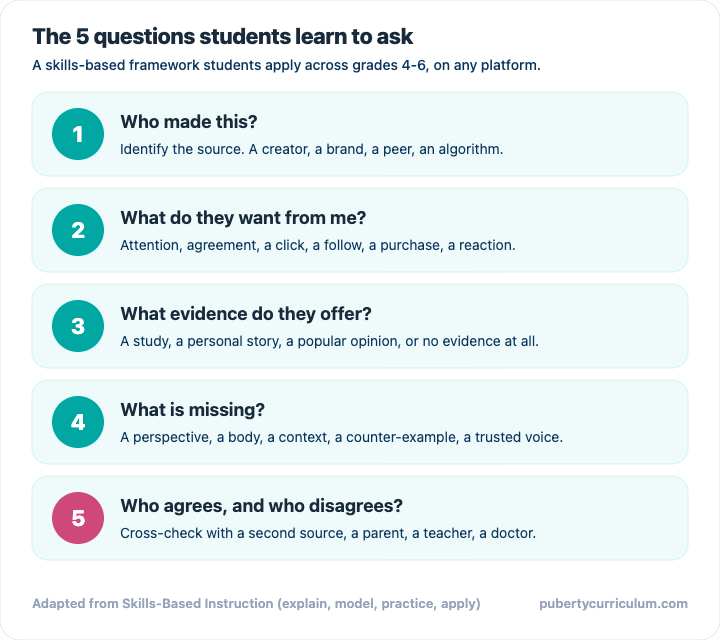
Drilled across multiple lessons, this becomes muscle memory. A student who has practiced the framework four times can use it on the next thing they see, without a teacher in the room. That is the difference between awareness and skill.
How a curriculum can do this without becoming a tech class
The strongest puberty programs do not add a separate “digital unit.” They thread media analysis into the puberty content that students are already engaged with. A lesson on how bodies change includes a brief look at how bodies are represented in advertising and short-form video. A lesson on healthy relationships includes a moment to compare a portrayal in a familiar show with what students themselves identified as healthy minutes earlier.
Puberty: The Wonder Years takes this approach across grades 4 through 6, with a dedicated Media and Information Literacy lesson in Grade 6 that covers technology and media impact on body image and sexual health, the role of sexually explicit media, the structured evaluation framework, and where to find trustworthy community resources. Earlier grades introduce the underlying habits: noticing what a message wants you to feel, asking who made it, checking it against another source.
Two methodology choices make this work. First, the Question Box methodology gives every student a written channel for questions, every lesson, including the “I saw something online and I don’t know what it was” questions that almost always exist. Teachers prepare answers between lessons using the curriculum’s appendix of model responses, which means no teacher is ever put on the spot. Second, trauma-informed design matters more here than in almost any other lesson. Some students have already encountered content that disturbed them. Content warnings, exit options, and Teacher Tips for handling disclosures are not nice-to-haves; they are the difference between a lesson that helps and a lesson that re-traumatizes.
What parents and teachers can do this week
You do not need a curriculum overhaul to start closing the gap. You need consistent language between home and school.
For teachers: when a student asks about something they saw online, treat the moment the way you would treat any sensitive question. Acknowledge it, name it as common, and route it through the same evaluation steps you use in class. The Question Box keeps the door open for the questions that did not surface today.
For parents: pick one show, one app, or one short video your child has actually seen this week. Watch a minute together. Ask the four small questions: who made it, what do they want, what is missing, and what does a trusted adult think. Repeat the same four questions next week with something else. This is how the framework moves from school to home.
Both moves rest on what the adapted Health Belief Model calls environmental support, the fourth factor that turns knowledge into behavior. Knowledge alone does not change what students do online. Coordinated reinforcement at home and at school does.
Choosing a curriculum that already does this
If you are evaluating a puberty curriculum this spring or summer, a short list of questions will tell you whether digital safety is meaningfully integrated or quietly skipped:
- Does the curriculum reference current platforms and current realities, or does it stop at “the internet”?
- Is there a structured information evaluation framework that students apply across multiple lessons, not a single warning slide?
- Are media literacy moves taught using a defined skills-based process, with practice and feedback, not just discussion?
- Is there a safe channel for students to ask about content they have already seen?
- Is the lesson trauma-informed, with content warnings and teacher guidance for sensitive disclosures?
- Are families given language to continue the same conversation at home?
A curriculum that can answer yes to all six is doing the integration work the moment requires. A curriculum that cannot is leaving the most pressing student questions for the algorithm to answer.
If you would like to see how a methodology-forward, family-engaged puberty curriculum handles digital safety in practice, you can review the relevant lessons before any purchasing conversation. The students in your building have already started this conversation online. The decision in front of you is whether the school will join it.