

Somewhere between the master schedule and a hallway conversation, it became official: you are teaching the puberty unit this year. If your reaction landed somewhere between mild discomfort and quiet panic, you are in good company. Most elementary teachers received little or no training in puberty education during their certification programs. Now you are expected to stand in front of a room of ten-year-olds and talk about changing bodies as calmly as you teach fractions.
Here is what we have learned in our years of working with schools: the teachers who dread this unit in August are often the same teachers who describe it in June as the most rewarding thing they taught all year. The difference is not that they became sexuality experts over one summer. The difference is structure. When the materials, the classroom climate, the question-handling process, and the family communication are all systematized, teaching puberty education becomes a matter of following a well-marked path rather than improvising in front of an audience.
This guide walks through how to teach puberty education as a first-timer: what to look for in your materials, how to set up your classroom, what to do with hard questions, and how to bring families along with you.
The Fears Are Predictable, and That Makes Them Solvable
When we ask teachers what worries them about teaching puberty education, the same three fears come up in nearly every conversation.
“What if I say the wrong thing?” Teachers worry about using inappropriate language, sharing too much, or phrasing something in a way that lands badly with a student or a parent.
“What if a student asks something I can’t answer?” This is the single most common fear teachers report. Puberty invites questions, and fifth graders do not screen theirs for comfort level.
“What if a parent complains?” Nobody wants to be the subject of an angry email chain or a school board comment.
Notice what these fears have in common: none of them is about your ability to teach. You already know how to manage a classroom, pace a lesson, and read a room. The fears are about content and controversy, and both of those can be handled by systems that exist before you ever stand up to teach.
| The fear | The system that answers it |
|---|---|
| “What if I say the wrong thing?” | Word-for-word lesson scripts with vetted, developmentally appropriate language |
| “What if a student asks something I can’t answer?” | The Question Box methodology: collect questions anonymously, prepare between lessons, answer at the next class |
| “What if a parent complains?” | Family engagement tools: introduction letter, curriculum outline, opt-out notification, signed Family Activity Sheets |
Research on program implementation backs this up: teacher preparedness is one of the strongest predictors of whether a health curriculum is taught as intended. Preparation is not just about your comfort. It directly shapes the quality of what students receive.
Let the Structure Do the Heavy Lifting
The most important decision you or your school will make happens before the first lesson: choosing materials that are built for non-specialists.
A curriculum designed for classroom teachers, rather than health educators, gives you word-for-word scripts for the sensitive moments. You are never left inventing language for anatomy, consent, or emotional changes on the fly. Every term has been chosen for developmental appropriateness, which means the wording question (“what if I say the wrong thing?”) has already been answered by someone whose job was to answer it.
Structure also matters at the level of instructional method. Puberty: The Wonder Years, for example, builds every lesson on the Skills-Based Instruction model, a four-step process: the teacher explains why a skill matters, models what it looks like, students practice it with feedback, and then apply it to realistic situations. The value of a consistent model for a first-time teacher is hard to overstate. Instead of performing expertise, you follow a process, and the process is the same in lesson six as it was in lesson one.

Look for Preparation Checklists too. Knowing that everything you need to gather, duplicate, and set up is itemized for each lesson removes the low-grade anxiety of wondering what you forgot.
You don’t need to be a sex education expert to teach sex education expertly.
Set the Classroom Climate Before the First Lesson
Experienced puberty educators spend their first lesson building the container, not delivering content. Students need to know the room is safe before they can learn anything about their changing bodies.
That starts with community guidelines: a structured agreement about respect, privacy, and how the class will handle laughter and discomfort. Giggles will happen. A good climate plan expects them, names them as normal, and moves on without shame.
It also means teaching from a trauma-informed foundation. Some students in your room have experiences you do not know about. Trauma-informed design means content warnings before sensitive topics, the option for a student to step out if something becomes overwhelming, and a firm rule against shaming or scare tactics. Well-designed materials build these supports in, including scripted content warnings, so you are not guessing how to open a difficult topic.
Keep the frame positive: PWY calls this the “Freedom To” philosophy. Puberty is presented as freedom to enjoy childhood, develop healthy relationships, and make informed decisions, rather than a parade of risks and warnings. Fear-based approaches have a long research record of not working. A positive frame is easier to teach, easier to defend, and far more pleasant for everyone in the room.
Use a System for Student Questions, Not Improvisation
Since the unanswerable question is the number one fear, it deserves its own system. The strongest one we know is the Question Box methodology, and it works like this: at the end of every lesson, every student writes something on a slip of paper, whether they have a question or not. Students with real questions stay anonymous because everyone is writing. Between lessons, you review what came in and prepare answers, supported in PWY’s case by appendices with more than 30 model questions and answers covering the most common and most sensitive things students ask. You open the next lesson by answering selected questions from the box.
Read that process again and notice what is missing: the moment where a student asks you something startling and thirty faces turn to watch you respond. That moment simply does not exist in a Question Box classroom. You always have time to prepare, and you always have model language to lean on. Students learn that every question gets taken seriously, and you learn that no question can ambush you.
Bring Families In Before You Teach Anything
Teachers often assume parents are the opposition. The data says otherwise: in national surveys, more than 84 percent of parents say they support sex education in schools. The loud objections you read about are real, but they are a minority, and most of them trace back to one root cause: families finding out about the program secondhand.
The fix is to communicate first, warmly, and in detail. Before the unit begins, families should receive an introduction letter, a full curriculum outline, and notification with the chance to opt out. Some schools add a preview night where parents can review the materials and meet you before lessons start. During the unit, tools like Family Activity Sheets, structured conversations that a parent or trusted adult signs, extend the learning home and give families an active role instead of a spectator seat.
For you as the teacher, this infrastructure is protective. When a concern surfaces, it lands on a documented foundation of transparency, and it becomes a conversation between partners rather than a confrontation between strangers.
A Summer Checklist for Day-One Confidence
If you are reading this over the summer with the unit on your fall calendar, here is a preparation sequence we recommend.
- Read the full curriculum once, cover to cover. Not to memorize it, just to remove the unknown. Note where the scripts and content warnings appear.
- Take the training if it is available to you. PWY offers a self-paced Online Training Course that covers both content knowledge and strategies for sensitive topics in about six hours. If you are weighing options, we have written a full guide to professional development options for puberty education.
- Read the first lesson’s script aloud. The vocabulary of puberty stops feeling awkward when your own voice has said it once in an empty room.
- Work through the first Preparation Checklist. Gather and duplicate what the opening lesson needs so day one has no scramble.
- Map your family communication timeline. Decide when the introduction letter, curriculum outline, and consent notification go home, and get them on the calendar.
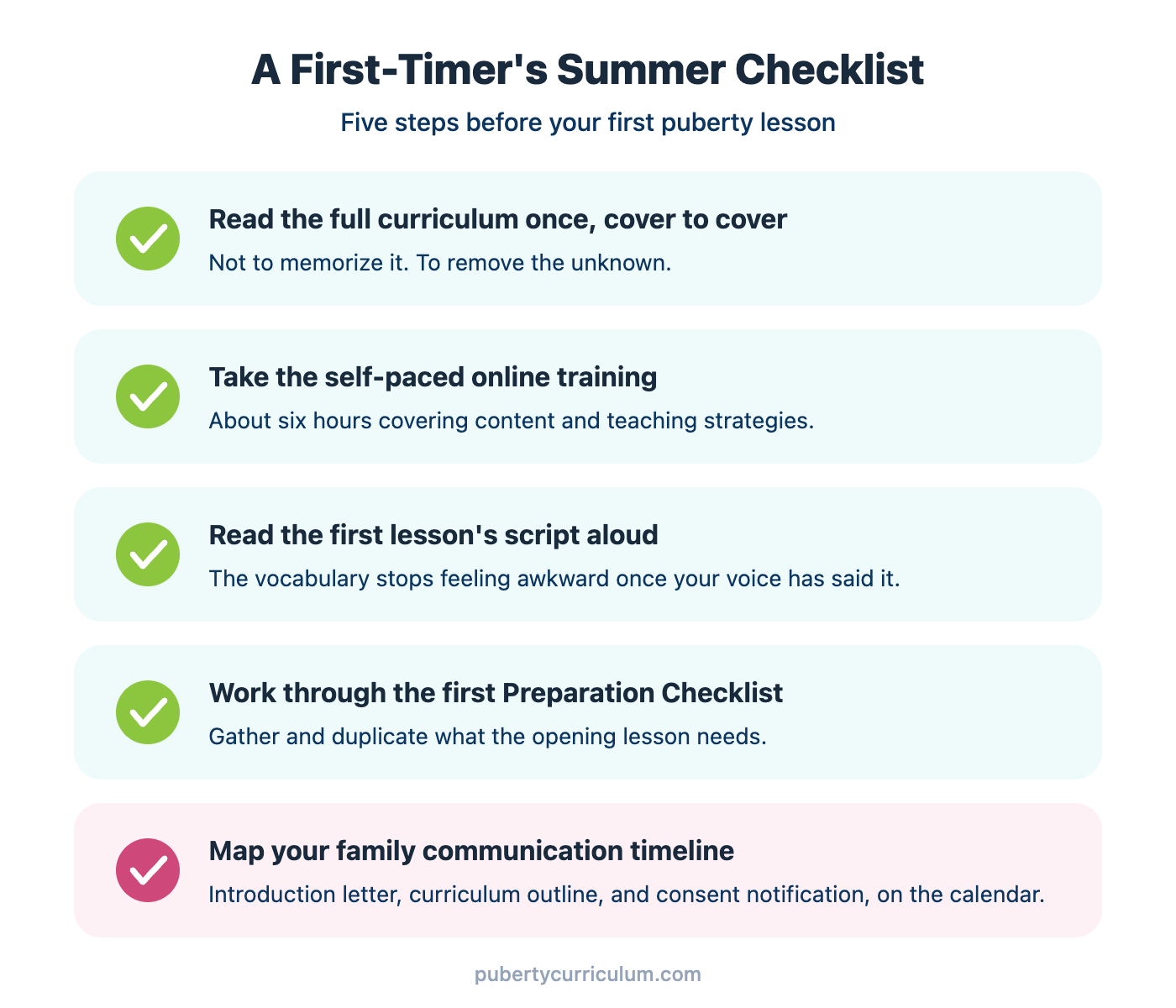
Five steps, none of them heroic. That is the honest answer to how to teach puberty education for the first time: a set of systems that carry the weight, so you can teach the way you already know how. You do not need to be a sex education expert to teach sex education expertly. You need materials that were built to make that sentence true.
If your school is still selecting materials, start with our guide on how to evaluate and choose a puberty curriculum. And if you want to see what fully scripted, teacher-ready lessons look like from the inside, request a free preview of Puberty: The Wonder Years and read the first lesson yourself.