

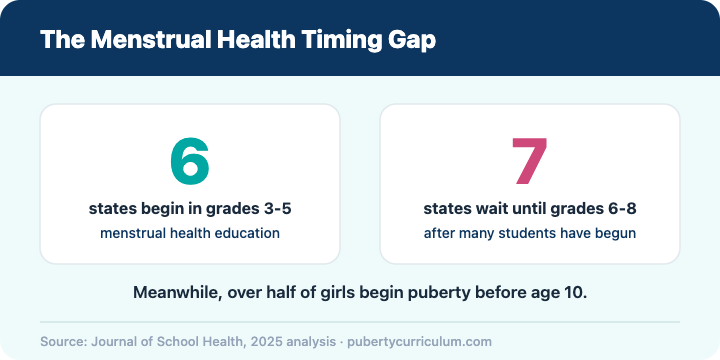
By the time many schools schedule their first lesson on periods, a meaningful share of students have already begun puberty, and some have already had their first period. Research summarized in the field shows that over half of girls now begin puberty before age 10. A first period usually arrives a year or more after those earliest signs, so menstruation itself is less common in fourth grade than the onset of puberty is, but the whole timeline has shifted earlier. A 2025 analysis published in the Journal of School Health found that only six states begin menstrual health education in grades 3 through 5, while seven states wait until grades 6 through 8. The result is a quiet timing gap, where the curriculum often arrives a year or two after a student’s body has started to change.
For curriculum directors and teachers planning instruction for grades 4 through 6, this gap reframes a familiar debate. The question is usually phrased as “is fourth grade too early to talk about menstruation?” A more useful question is whether waiting is already too late for the students who need the information first. May offers a natural moment to revisit this, with Menstrual Hygiene Day on May 28 putting the topic in front of educators and families alike.
This guide walks through when menstrual health education belongs in the grade 4-6 sequence, what a complete lesson actually covers, and how to teach it in a way that supports both students and the teacher standing in front of the room.
The timing gap most schools do not realize they have
Historically, many schools placed puberty education in fifth grade, and often near the end of the year. That made sense a generation ago. It makes less sense now that the first signs of puberty, including breast development, are appearing roughly a year earlier than they did decades ago for many children. When instruction lands after the body has already changed, students are left to interpret a confusing experience on their own, frequently with information pulled from older siblings, group chats, or whatever a search engine surfaces.
Starting earlier does not mean teaching everything at once. It means meeting students with foundational, age-appropriate information before or as changes begin, then building on it. A spiraled approach across grades 4, 5, and 6 introduces the basics of the menstrual cycle and personal hygiene at an introductory level, then returns to the topic with more depth as students mature. In our work with schools, the districts that feel calmest about this topic are usually the ones that start a little earlier and revisit it, rather than the ones trying to cover everything in a single late lesson. We have written more about why puberty is starting earlier and whether schools are keeping up.
What menstrual health education actually covers at this age
Strong menstrual health education for this age band is not an anatomy lecture. It is a combination of accurate information, the confidence to use it, the practical skills to manage day-to-day situations, and a classroom culture where the topic is treated as ordinary. It also means using medically accurate, inclusive language, since not every student who menstruates identifies as a girl, and students reach this stage on different timelines.
This is where PWY’s adapted Health Belief Model is useful as a planning lens. The model identifies four factors that have to be present for students to act on what they learn: knowledge, self-efficacy, skills, and environmental support. Applied to menstrual health, that means students learn what the menstrual cycle is and why it happens (knowledge), come to see it as a normal, manageable part of growing up rather than something frightening (self-efficacy), practice concrete skills like tracking changes and knowing what to do and whom to ask when a period starts at school (skills), and experience a classroom and home environment that reinforces all of it (environmental support).

Most curricula stop at the first factor. They explain the biology and move on. Lessons that address all four are the ones that change how a student actually experiences their first period.
Why a positive frame matters more here than almost anywhere
A student’s earliest lessons about menstruation tend to set the emotional tone for years. If the message is delivered with discomfort, hushed voices, or warnings, students absorb the idea that this is something to hide. If it is delivered as a normal part of human development, they are far more likely to ask questions, seek help, and support their classmates rather than tease them.
PWY’s “Freedom To” philosophy is built for moments like this. Rather than framing puberty through fear, it frames it through possibility: the freedom to enjoy childhood, to understand one’s own body, and to make informed decisions. For menstrual health, that translates into language that celebrates a healthy, developing body instead of treating menstruation as a problem to be managed quietly.
A student’s first lessons about menstruation set the emotional tone for years. Deliver them as normal, and students ask questions instead of hiding.
Trauma-informed design supports the same goal. Some students arrive with anxiety or difficult experiences around their bodies, and a few may have already started menstruating without preparation. Content warnings before sensitive material, the option to step out, and a strict no-shaming approach keep the classroom safe for every student, including the one who has been dreading this particular lesson.
Teaching it without putting the teacher on the spot
The most common worry educators raise about teaching periods, and puberty generally, is not the content. It is the unexpected question. What happens when a fourth grader asks something the teacher was not ready for, in front of the whole class.
The Question Box methodology removes that pressure. Every student writes a question or comment at the end of each lesson and places it in the box, which protects the anonymity of the students with real questions because everyone participates. The teacher reviews the questions between lessons, prepares answers using a bank of model responses for common and sensitive topics, and addresses selected questions at the start of the next lesson. Teachers are never caught off guard, because they always have time to prepare and a reference to draw from.
The Skills-Based Instruction 4-step model gives the lesson itself a reliable shape: explain why a skill matters, model what it looks like, let students practice with feedback, then apply it to realistic situations. For menstrual health, that might mean moving students from understanding the cycle to confidently knowing what to do if a period starts during the school day. A teacher following the four steps does not need to be a health expert. They need a clear process, which is what the structure provides.
Bringing families in, not leaving them out
Menstrual health is one of the topics where families most want to know what the school is teaching, and where home reinforcement matters most. Handled with transparency, it becomes a partnership rather than a flashpoint.
This is the heart of PWY’s home-school partnership philosophy. Family Activity Sheets send structured, signature-required conversations home, so a parent or trusted adult is part of the learning rather than hearing about it secondhand. Family Partnership Flyers explain what is being taught and offer tips for continuing the conversation at home, in English and Spanish. When families understand that menstrual health instruction is age-appropriate, medically accurate, and respectful of their role, opt-outs tend to fall and trust tends to rise. The research base agrees: parent engagement improves outcomes, and surveys consistently show that more than 84% of parents support sex education in schools.
The partnership advantage: When the same message reaches students at school and at home, menstrual health stops being a one-time talk and becomes ongoing support. Transparency with families is what makes that possible.
A short checklist for evaluating your current approach
If you are reviewing your own program, these five questions offer a quick self-audit:
- Does menstrual health instruction begin before or as students typically start puberty, or does it arrive afterward?
- Does the lesson build knowledge, confidence, and practical skills, or does it stop at biology?
- Is the tone positive and normalizing, free of fear and shame?
- Do teachers have a system, such as a structured question process, so they are never improvising answers to sensitive questions?
- Are families informed and equipped to continue the conversation at home?
If you answered “not sure” or “no” to more than one, the timing or the design of your instruction may be worth revisiting. For a fuller framework, our guide on how to evaluate and choose a puberty curriculum walks through the rest of the criteria. Puberty education that lands at the right time, in the right tone, with the right support behind the teacher is what helps students move through this stage with knowledge and dignity.
To see how a spiraled, skills-based approach handles menstrual health across grades 4 through 6, you can request a free curriculum preview and review the full scope and sequence for yourself.