

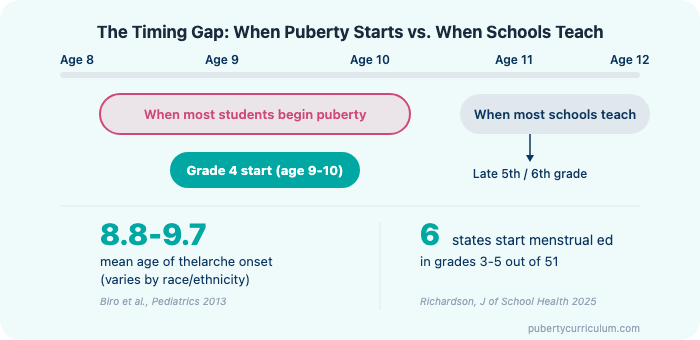
Research on puberty timing has shifted substantially over the past two decades. A 2013 longitudinal study by Biro and colleagues followed more than 1,200 participants and reported median onset of breast development between ages 8.8 and 9.7 across the racial and ethnic groups studied. The researchers observed earlier onset than prior studies had documented, with important differences associated with race, ethnicity, and body mass index.
Content reviewed and updated: August 24, 2026.
And yet, most schools still wait until late 5th grade, sometimes 6th, to begin puberty education. By the time instruction arrives, many students have already spent months navigating body changes, emotional shifts, and peer conversations without the language or context to make sense of what is happening to them.
The research is clear: puberty is starting earlier. The question for schools is whether their curriculum timing reflects that reality.
The Numbers Have Changed
Historically, many districts selected 5th grade as the year for puberty education. This made sense when most students began puberty around age 11 or 12. But the data has shifted significantly.
The trend toward earlier onset is not limited to one demographic group. Studies have documented earlier puberty across racial and ethnic populations, though the timing varies. Black and Hispanic female-bodied students have consistently shown earlier average onset than white peers in U.S.-based longitudinal studies, a finding that carries important implications for equitable curriculum timing. The pattern in male-bodied students, while less extensively studied, points in the same direction.
A 2025 analysis in the Journal of School Health reviewed public education standards for all 50 states and Washington, D.C. It found that 13 standards included menstruation. Six began that education in grades 3-5, and seven began in grades 6-8. The other 38 standards reviewed did not include menstruation.
The factors driving earlier onset are multifaceted. Researchers have identified contributions from improved nutrition, rising childhood obesity rates, environmental exposures including endocrine-disrupting chemicals (EDCs), and psychosocial stressors. These factors show no signs of reversing.
The result is a growing gap between when students experience puberty and when schools teach about it.
Why the Timing Gap Matters
This is not just an academic concern. Students who are already experiencing puberty when instruction begins have missed the window for proactive preparation. Instead of learning about body changes before they happen, these students are trying to make sense of changes they have already encountered, often through incomplete information from peers or online sources.
The consequences of late instruction are significant. Students who lack accurate information about puberty report higher anxiety about body changes, more confusion about what is normal, and greater vulnerability to misinformation. When schools wait until most students are mid-puberty, the instruction shifts from preparatory to reactive, and that changes both its effectiveness and its emotional impact.
Why timing matters (adapted Health Belief Model): The behavioral science framework behind effective puberty education identifies four factors that must be present for healthy development: knowledge, self-efficacy, skills, and environmental support. When instruction arrives after puberty has already begun, the self-efficacy factor is particularly at risk. Consistent with HBM logic, students who have been confused or anxious for months may have already internalized uncertainty about their bodies. Building confidence proactively is more effective than building it reactively.
Where State Requirements Fall Short
The policy landscape adds another layer of complexity. In many states, the timing of puberty education is either unspecified or pegged to grade levels that no longer align with developmental reality. Curriculum directors navigating this environment face a structural challenge: state requirements may not require instruction early enough, but they rarely prohibit it either.
This creates an opportunity. Districts are not limited to the minimum timeline their state requires. A school in a state that mandates puberty education in 6th grade can still begin foundational instruction in 4th grade without violating any policy. The mandate sets a floor, not a ceiling.
The key is understanding that “earlier” does not mean “more advanced.” Starting puberty education in 4th grade does not mean teaching the same content that 6th graders receive. It means introducing the right concepts at the right developmental stage.
What Earlier Instruction Should Look Like
A well-designed early curriculum looks different from what many people imagine. Grade 4 instruction focuses on physical, social, and emotional changes during puberty; an introduction to the reproductive system; personal hygiene; communication with trusted adults; and foundational concepts of gender identity and expression. The language is simple, direct, and age-appropriate.
By Grade 5, students are ready for deeper content: reproductive anatomy and physiology, puberty changes in greater detail, consent and boundaries, and the social-emotional dimensions of growing up. By Grade 6, the curriculum expands to healthy versus unhealthy relationships, media literacy, refusal and reporting skills, and intersectionality.
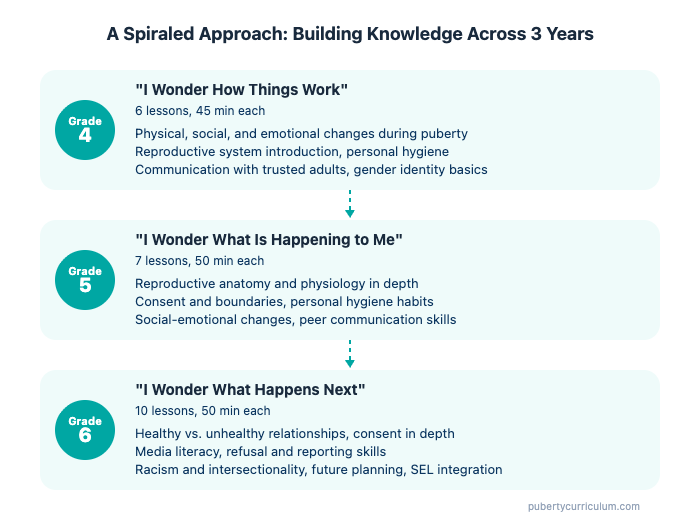
This spiraled approach, where each year builds on the last, is what the research supports. Students receive information when it is most relevant to their developmental stage, and they revisit core concepts with increasing depth as they mature.
When puberty is framed as something to appreciate rather than fear, students engage with the material instead of shutting down.
The “Freedom To” philosophy is particularly important for younger students. When the message is “freedom to enjoy childhood, develop healthy relationships, and make informed decisions,” positive framing produces better outcomes than scare-based approaches at every age. The difference is especially pronounced with 4th and 5th graders who are just beginning to think about these topics.
The Skills-Based Instruction 4-step model (explain and motivate, model and demonstrate, practice with feedback, apply to real-life situations) ensures that students are not just receiving information but building genuine communication, decision-making, and help-seeking skills from the start. A student who practices asking a trusted adult about a body change in 4th grade has a foundation to build on when more complex conversations arise in 5th and 6th grade.
How to Evaluate Whether Your Curriculum Timing Is Right
If you are evaluating your district’s puberty education program, here are five questions worth asking:
| Question | What to Look For |
|---|---|
| 1. When does instruction begin relative to current puberty onset data? | If your curriculum starts in 5th or 6th grade, a significant portion of students will already be experiencing the changes you are teaching about. Current research supports starting no later than 4th grade. |
| 2. Is the curriculum spiraled across multiple years? | A single-year “puberty unit” cannot address the full range of changes students navigate between ages 9 and 12. Look for curricula spanning at least two, ideally three, grade levels. |
| 3. Does the early instruction match the developmental stage? | Grade 4 content should be foundational and positive, not a watered-down version of what older students learn. Language, activities, and framing should be designed specifically for that age. |
| 4. Is the curriculum aligned to the National Sex Education Standards? | The NSES (2nd edition, 2020) provides an evidence-based benchmark for what students should know at each grade band. Alignment signals timing and content are informed by expert consensus. |
| 5. Does the program support teachers new to teaching younger students? | Earlier instruction requires teacher preparation. A curriculum with detailed scripts and trauma-informed design ensures teachers feel confident. |
The Window Is Closing Earlier Than You Think
The gap between when puberty starts and when schools teach about it will not close on its own. Biology is not waiting for policy to catch up. Districts that adjust their curriculum timing now, that begin instruction in Grade 4 and build progressively through Grade 6, will serve their students better than those waiting for state mandates to change.
The good news is that making this shift does not require building something from scratch. It requires choosing a curriculum designed with this timing in mind, one that starts early, spirals across grades, and supports teachers at every step.
Wondering whether your current curriculum starts early enough? Request a free curriculum preview to see how a spiraled, Grade 4-6 approach prepares students before puberty arrives, not after.