

You know the call is coming. Maybe not today, maybe not this semester, but at some point, a parent or caregiver will phone the office with concerns about what their child is learning in puberty education class. For many administrators, the anticipation of that call shapes every decision about sex education: when to teach it, how much to cover, and whether to invest in a structured program at all.
Here is the good news. Most parent complaints about puberty education are preventable. Not through watering down the curriculum, and not by avoiding the subject altogether, but through a proactive approach to communication, transparency, and partnership that turns potential critics into informed allies.
Why Most Parent Complaints Are Preventable
Research consistently shows that over 84% of parents support sex education in schools. The gap between that number and the volume of complaints schools receive reveals something important: most objections are not about the content itself. They are about surprise.

A parent or caregiver who discovers what their child is learning through a conversation at the dinner table, rather than through a letter from the school, feels blindsided. A family member who hears a secondhand account of a lesson, without context about the curriculum’s philosophy or age-appropriate design, fills in the blanks with their worst assumptions.
The schools that experience the fewest complaints are not teaching less. They are communicating more, and they are communicating earlier.
Start With Transparency, Not Persuasion
The instinct when introducing a puberty education program is to sell it: to lead with research, cite endorsements, and build a case for why this matters. That approach often backfires with skeptical parents because it feels like the decision has already been made and they are being managed.
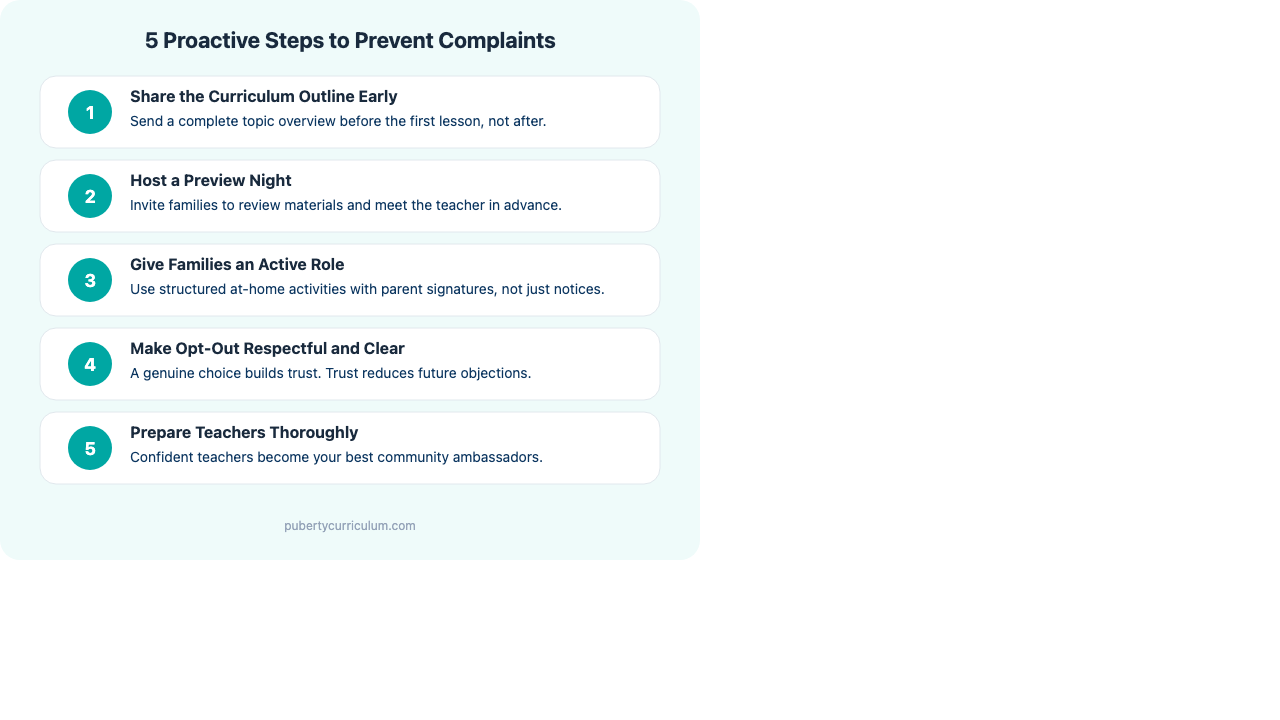
A more effective approach is radical transparency. Before the first lesson, share:
- A complete curriculum outline showing every topic that will be covered
- An introduction letter explaining the program’s goals and approach
- An invitation to a preview night where families can review the actual materials and meet the teacher
This level of openness communicates respect. It says: “We have nothing to hide, and we value your input.” When your curriculum is aligned to recognized standards like the National Sex Education Standards (NSES) and Common Core ELA, sharing that alignment documentation gives families and board members a concrete, evidence-based framework they can evaluate.
“Freedom To” philosophy: Programs built on positive framing, like freedom to enjoy childhood, develop healthy relationships, and make informed decisions, are particularly easy to share transparently. Positive framing resonates with parents in ways that risk-centered messaging does not.
Give Families a Role, Not Just a Notice
Transparency is necessary but not sufficient. The difference between a school that informs parents and a school that partners with parents is whether families have a meaningful role in the learning process.
Structured tools like Family Activity Sheets, which are designed as at-home conversations that require a parent or trusted adult signature, transform the dynamic entirely. When a parent sits down with their child to complete a guided activity about puberty, they are no longer an outside observer. They are a participant.
Family Partnership Flyers serve a similar function, providing parents with tips and resources for continuing conversations at home. These are not generic permission slips. They are conversation starters that position the family as the child’s primary educator about values, with the school as a supportive partner.
Schools that use a robust family engagement approach report a consistent pattern: opt-out rates decline over time.
Not because parents are pressured, but because they see the curriculum’s quality firsthand through the materials that come home.
Make the Opt-Out Process Respectful and Clear
It may seem counterintuitive, but making it easy for parents to say no is one of the most effective ways to reduce complaints.
A clear passive consent process, where parents are notified and their child participates unless the family opts out, communicates two things simultaneously. First, the school respects parental authority. Second, the school is confident enough in the program to give families a genuine choice.
What Works
- Clear, straightforward opt-out letter
- Explanation of what is being taught and why
- Invitation to preview materials
- Respectful tone throughout
What Backfires
- Skipping notification entirely
- Burying opt-out details in dense paperwork
- Making the process feel dismissive
- Treating parental choice as an obstacle
In states where opt-in policies apply, proactive engagement becomes even more critical, because it is the difference between high participation rates and classrooms with half the students absent.
Prepare Your Teachers to Be the Best Ambassadors
Parent concerns rarely arrive through formal channels first. More often, they surface as questions at back-to-school night, comments in the pickup line, or emails to the classroom teacher. How teachers handle these moments determines whether a concern stays small or escalates.
Teachers who feel prepared, who have taught from detailed scripts and used the Question Box methodology to systematically handle student questions, carry that confidence into parent interactions. They can describe what they are teaching, explain why, and reference the curriculum’s approach with specificity.
Teachers who are anxious about the material, who pieced together their own resources and are uncertain about their language, are far more likely to stumble in those conversations. That stumble, even if minor, can erode a parent’s trust.
Investing in teacher preparation, whether through training courses or through a curriculum with built-in Skills-Based Instruction that guides teachers through a consistent 4-step process (explain, model, practice, apply), pays dividends not just in classroom quality but in community trust.
What to Do When a Complaint Does Arrive
Even with the strongest prevention strategies, some concerns will come through. That is normal and healthy. A parent who raises a concern is a parent who cares enough to engage.
When a complaint arrives:
| Step | Action | Why It Matters |
|---|---|---|
| 1. Listen first | Let the parent describe their concern fully before responding. Acknowledge their feelings. | Parents who feel heard are far less likely to escalate. |
| 2. Reference documentation | Point to the curriculum outline, introduction letter, and opt-out process you shared in advance. | Your paper trail shows the school acted transparently. |
| 3. Offer specifics | Invite the parent to review the actual lesson materials in context. | Most objections dissolve when parents see the content firsthand. |
| 4. Follow up | Send a brief follow-up call or email after the conversation. | Shows the school takes the concern seriously. |
Most complaints resolve in a single conversation when the parent feels heard and sees that the program was implemented thoughtfully.
The Pattern Is Clear
The schools with the fewest parent complaints about puberty education share a common approach. They communicate before they teach. They give families real tools, not just notices. They respect the opt-out process. They prepare their teachers thoroughly. And they treat concerns as opportunities to build trust rather than threats to manage.
Controversy about puberty education is real, but it is not inevitable. With the right infrastructure, your sex education program can become a source of community confidence rather than community conflict.
Ready to see what proactive family engagement looks like in practice? Request a free curriculum preview to explore how Puberty: The Wonder Years builds home-school partnerships into every lesson.