

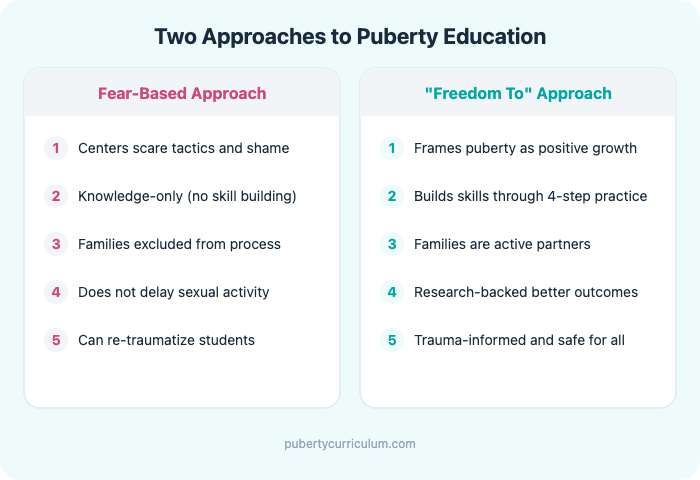
Decades of research have reached the same conclusion: fear-based sex education does not delay sexual activity, reduce teen pregnancy, or lower STI rates. The American Academy of Pediatrics, the American Medical Association, and the Society for Adolescent Health and Medicine all endorse comprehensive approaches over scare tactics. Yet many schools still rely on programs that center fear, shame, and worst-case scenarios as their primary teaching tools.
If your school is evaluating puberty education options, or if you are a parent wondering what approach your child’s school is using, the research points clearly in one direction: positive, skills-based programs produce better outcomes than fear-based ones. Here is why, and what to look for.
The Problem with Fear as a Teaching Strategy
Fear-based puberty and sex education programs typically rely on a few common tactics: graphic images of STI symptoms, exaggerated statistics about pregnancy risk, stories designed to frighten students into abstinence, and language that frames sexual development as something dangerous. The underlying assumption is that if students are scared enough, they will avoid risky behavior.
The research tells a different story. Studies spanning decades have consistently found that abstinence-only programs, which rely heavily on fear-based messaging, do not delay the onset of sexual activity. They do not reduce teen pregnancy rates. And they leave students without the communication and decision-making skills they need when they do face real-world situations.
There is a deeper problem, too. Fear-based approaches can harm students who have already experienced trauma. When a curriculum uses scare tactics or shaming language, students who have experienced abuse, unwanted contact, or early exposure to sexual content may feel blamed, isolated, or re-traumatized. A program designed to protect students should never make them feel less safe.
What Positive Puberty Education Looks Like
Positive puberty education starts from a fundamentally different premise. Instead of framing sexual development as something to fear, it treats puberty as a normal, healthy part of growing up, something students can navigate with knowledge, confidence, and support.
This is the foundation of what some educators call the “Freedom To” philosophy: freedom to enjoy childhood, freedom to develop healthy relationships, freedom to reach their goals, and freedom to make informed decisions. Positive framing does not mean avoiding difficult topics. It means approaching those topics in a way that builds understanding rather than anxiety.
In practice, this looks like:
- Lessons that celebrate physical and emotional growth rather than centering danger
- Language that is medically accurate, inclusive, and free of shame
- A classroom climate built on respect and safety, established through clear community guidelines
- Content warnings before sensitive topics, so students and teachers are prepared
- Exit options for students who need them, with no stigma attached
The difference is not about avoiding hard conversations. It is about having those conversations in a way that leaves students feeling informed and empowered, not frightened and confused.
Why Skills Matter More Than Scare Tactics
One of the most important findings in puberty education research is that knowledge alone does not change behavior. A student can memorize every fact about puberty, anatomy, and risk, and still lack the ability to communicate boundaries, refuse unsafe situations, or make thoughtful decisions under pressure.
The adapted Health Belief Model: Behavioral science identifies four factors that must be present for healthy behavior: knowledge, self-efficacy, skills, and environmental support. Most fear-based programs address only the first factor. They deliver information (often with a heavy dose of fear) and stop there.
Effective programs go further. They use a structured instructional approach, like Skills-Based Instruction, where every skill is taught through a consistent four-step process: explain why the skill matters, model what it looks like, let students practice with feedback, and apply it to real-life situations. Students do not just hear about consent; they practice asking for permission, listening for the answer, and respecting the response. They do not just learn about refusal; they rehearse specific strategies through role play in relevant contexts.
This is the difference between a student who can define consent on a test and a student who can actually communicate a boundary in a real conversation with a peer.
The Role of Family Partnership in Positive Approaches
Fear-based programs often operate in a silo. Students receive the information at school, and families are left out of the conversation, or worse, blindsided by content they did not expect.
Positive programs take the opposite approach. They treat families as partners, not obstacles. This means providing parents with clear information about what is being taught before lessons begin, giving families the choice to participate or opt out, and sending home structured conversation starters that invite parents to discuss their own values with their child.
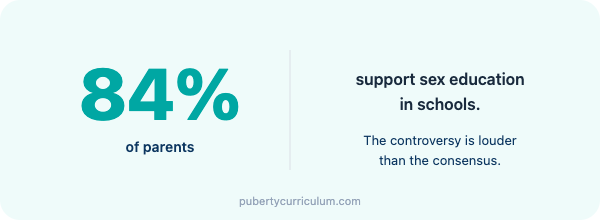
This transparency is not just good practice. It is strategic. Over 84% of parents support sex education in schools. The controversy around puberty education is louder than the consensus. When schools communicate proactively and give families a role in the learning process, opt-out rates decrease over time and community trust grows.
Look for curricula that include tools like parent introduction letters, curriculum outlines shared before instruction begins, and structured at-home activities that require a parent or trusted adult conversation. These are the signals that a program was designed with the home-school partnership in mind.
How to Recognize a Positive Puberty Program
Not every program that claims to be “comprehensive” or “evidence-based” meets the standard. Here are the criteria that matter:
| What to Look For | What It Means |
|---|---|
| Positive framing | Program frames puberty as something to appreciate and navigate with confidence, not as a source of fear |
| Skills-based instruction | Students practice communication, decision-making, and refusal skills, not just receive information |
| Family engagement tools | Program includes parent letters, curriculum outlines, and at-home activities for families |
| Trauma-informed design | Content warnings, exit options, and teacher guidance for emotional moments are built in |
| Standards alignment | Aligned to recognized standards like the National Sex Education Standards |
| Defensible framework | Built on a behavioral science model that explains why it works, not just what it covers |
A program that checks all of these boxes is not just a better choice philosophically. It is a more defensible choice for administrators, a more reassuring choice for parents, and a more effective one for students.
What This Means for Your School
Choosing a positive approach to puberty education is not about being permissive or avoiding hard truths. It is about following the evidence. The research is clear: programs that build skills, engage families, and frame puberty positively produce better outcomes than programs that rely on fear.
If your school is currently using a fear-based or outdated program, or if you are evaluating options for the first time, start by asking the questions above. Look for a standards-aligned puberty curriculum that includes family engagement tools and teaches skills through practice, not just presentation.
Want to see what positive, skills-based puberty education looks like in action? Register for our free May 21 webinar, “Puberty Happens: Meeting Your 4th Graders Where They Are,” where we walk through real lessons and answer your questions live. Or request a free curriculum preview to evaluate the materials on your own timeline.