

You are three lessons into the puberty unit when it happens. A student’s eyes go wide during a discussion about body changes. Their hand shoots up, not to ask a question, but to ask to leave. Or maybe they don’t ask at all. Maybe they just shut down, and you notice too late.
If you teach puberty education, moments like these are not hypothetical. They are a matter of when, not if. Trauma exposure is common among school-age children, and puberty education, by its very nature, touches on topics that can connect to a student’s most difficult experiences: bodies, boundaries, relationships, and safety.
The question is whether your curriculum prepares you for these moments or leaves you to figure it out alone.
Why Trauma-Informed Matters for Puberty Education Specifically
Trauma-informed teaching has become a priority across many subjects, but it carries particular weight in puberty education. The topics are inherently personal. When you teach about body changes, bodily autonomy, consent, or healthy relationships, you are covering ground that may intersect with a student’s trauma history in ways that a math or reading lesson never would.

For children in grades 4 through 6, the developmental stage where puberty education typically begins, these experiences are often recent and unprocessed.
A trauma-informed approach does not mean avoiding difficult topics. It means teaching them in a way that minimizes the risk of re-traumatization while keeping the learning environment productive for all students. This distinction matters: puberty education is too important to skip, and students deserve to receive it in a setting that feels safe.
What a Trauma-Informed Puberty Lesson Looks Like, Step by Step
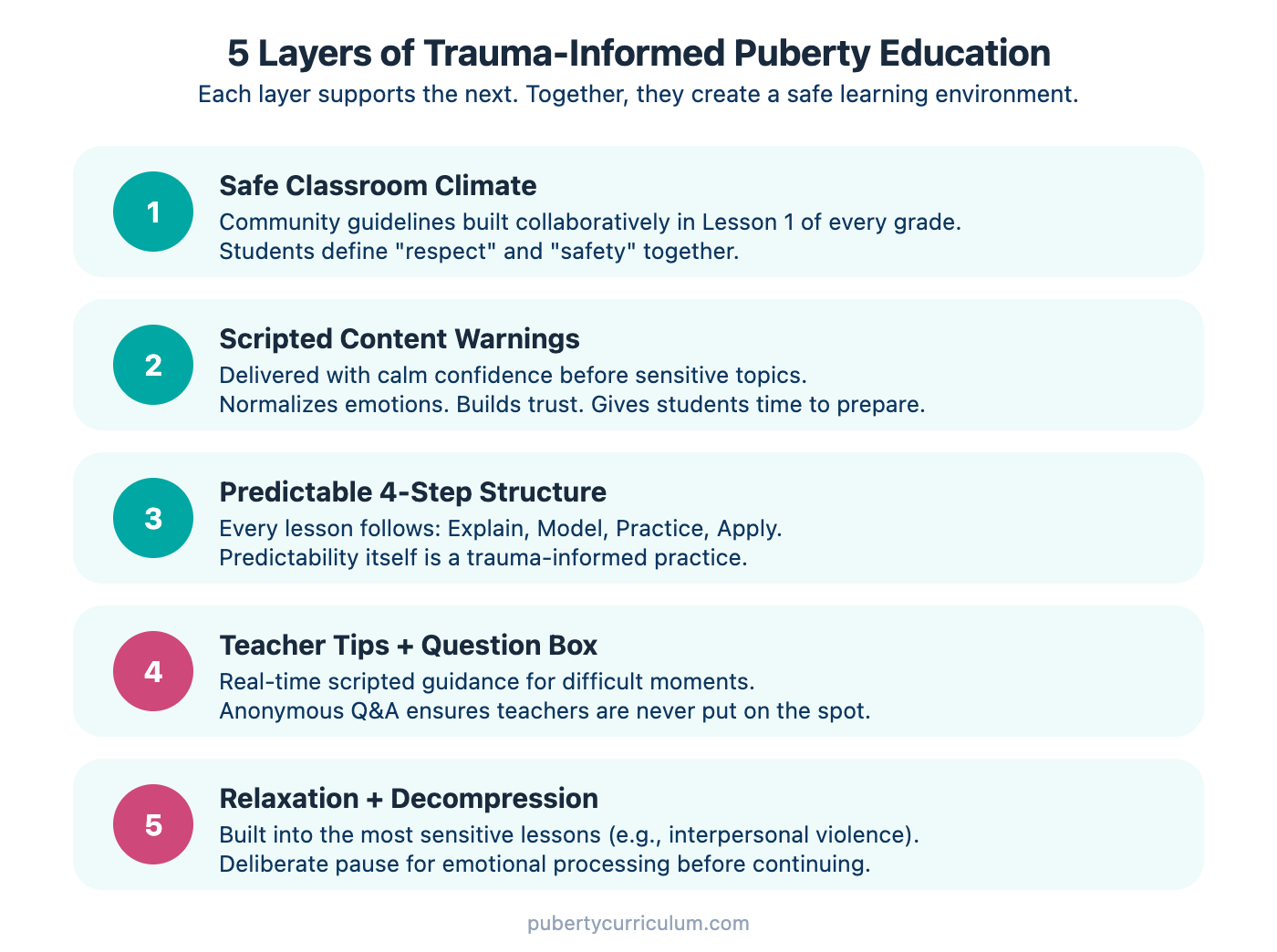
In practice, trauma-informed puberty education is built on layers of preparation and support, not a single technique. Here is what it looks like when the elements are designed into the curriculum rather than improvised by the teacher:
| When | What Happens | Support Built In |
|---|---|---|
| Before the lesson | Teacher reviews sensitive topic flags | Preparation checklist with scripted language |
| Start of lesson | Content warning delivered | Scripted warnings, predictable 4-step structure |
| During the lesson | Emotional reactions may surface | Teacher Tips with real-time guidance |
| Sensitive lessons | Heavy topics (e.g., interpersonal violence) | Relaxation and decompression techniques |
| End of every lesson | Students process privately | Question Box: every student writes, teacher prepares answers |
This is where the Skills-Based Instruction model intersects with trauma-informed design. The four-step process (explain, model, practice, apply) gives every lesson a predictable structure, and predictability itself is a trauma-informed practice. Students know what to expect.
For the most sensitive lessons, such as those covering interpersonal violence, the curriculum includes relaxation and decompression techniques. These give students time to process emotional reactions before the lesson continues. This is not filler time. It is a deliberate instructional choice that acknowledges the weight of the content.
At the end of every lesson, the Question Box methodology provides a safe channel for students who could not voice their thoughts during class. Every student writes something, a question or a comment, and places it in the box. This protects the anonymity of students who have real concerns, because everyone participates. Teachers then prepare thoughtful answers using model Q&As before the next lesson.
How Content Warnings Set the Stage Without Creating Fear
Content warnings are sometimes misunderstood as coddling or as signals that the material is inappropriate. In a trauma-informed framework, they serve a different purpose entirely. They are a trust-building tool.
When a teacher says, “Today we are going to talk about body boundaries and situations where someone might touch you in a way that is unwelcome. Some of you may have strong feelings about this topic, and that is completely normal,” they are accomplishing several things at once. They are normalizing emotional responses. They are giving students a moment to prepare. And they are demonstrating that the teacher is in control of the classroom and has anticipated what might come up.
Content warnings delivered with anxiety can create the very fear they are meant to prevent. Content warnings delivered with calm confidence set a tone of safety.
This is why scripted content warnings matter. They remove improvisation from a moment where precision counts.
The Teacher’s Safety Net: Scripted Support for Difficult Moments
The number one fear teachers report about puberty education is not the content itself. It is the unpredictable moments: the student who asks a question you did not expect, the child who starts crying, the disclosure that changes the entire dynamic of the room.
Trauma-informed curriculum design addresses this directly. Teacher Tips placed throughout each lesson anticipate the most common difficult moments and provide specific guidance. These are not theoretical suggestions. They are practical, scripted responses a teacher can use or adapt in real time.
Combined with the Question Box methodology, which ensures teachers never have to answer sensitive questions on the spot, this creates a genuine safety net. The teacher always has time to prepare, always has model answers to reference, and always has guidance for the emotional dynamics of the classroom.
For administrators evaluating curricula, this matters because it reduces risk. A teacher with built-in support is far less likely to say something off-message, handle a disclosure inappropriately, or freeze during a critical moment.
Creating a Safe Classroom Climate Before the First Lesson
Trauma-informed puberty education does not begin with the first lesson on body changes. It begins with climate-building. In effective curricula, the opening lesson of every grade level is dedicated to establishing community guidelines: the shared agreements about how students will treat each other during these discussions.
This is more than posting a list of rules. It is a collaborative process where students help define what “respect” and “safety” look like in their classroom. When students have ownership of the climate, they are more likely to uphold it.
The community guidelines serve as a reference point throughout the unit. When a student laughs at a question or makes a comment that undermines safety, the teacher can redirect by pointing to the agreements the class created together, not by imposing authority from above.
What Administrators Should Look For
If your district requires trauma-responsive instruction, and an increasing number do, here is what to look for when evaluating a puberty curriculum:
Trauma-informed IS
- Content warnings delivered with calm confidence
- Scripted teacher support at point of need
- Predictable lesson structure (4-step model)
- Exit options for overwhelmed students
- Community guidelines built collaboratively
Trauma-informed IS NOT
- Avoiding difficult topics entirely
- Teachers improvising during emotional moments
- Unpredictable, unstructured lessons
- Forcing participation with no opt-out
- Rules imposed top-down by the teacher
No shaming or scare tactics. Any curriculum that uses fear, guilt, or shame as motivational tools is fundamentally incompatible with trauma-informed practice. Look for curricula built on a positive philosophy like the “Freedom To” approach: freedom to enjoy childhood, develop healthy relationships, reach goals, and make informed decisions. This kind of positive framing turns puberty into something students can appreciate, not fear.
Alignment to recognized standards. The National Sex Education Standards (2nd edition, 2020) explicitly call for trauma-informed, skills-based instruction. Curricula aligned to NSES and the National Health Education Standards provide a defensible framework for districts navigating this requirement.
Trauma-informed puberty education is not an extra layer of work. When it is designed into the curriculum from the start, it is simply good teaching, the kind that serves every student, including those carrying experiences they have not yet found the words for.
Ready to see what trauma-informed puberty education looks like in practice? Request a free curriculum preview and explore the lessons, Teacher Tips, and support tools built into every grade level.