

You are four minutes into the first puberty lesson of the year. You say the name of a body part, and somewhere in the third row a student snorts. Two more catch it. Within seconds half the room is laughing, the other half is studying the floor, and you are at the front deciding whether to wait it out, joke along, or raise your voice.
Every teacher who has taught puberty education has a version of that moment. In our work with schools, it comes up in almost every conversation about teacher confidence. Teachers tell us their materials get mocked. “The kids laugh at the videos” is a sentence we have heard in district after district.
The laughter is predictable, and predictable things can be planned for. Here is what the giggling usually means, what to do when it starts, and which decisions keep it from taking over the unit in the first place.
What the Laughter Is Actually Telling You
Much of the giggling during puberty lessons is a discomfort-management strategy. You are asking fourth through sixth graders to sit with information about their own changing bodies, in a room full of peers whose opinions have started to matter far more than they did a year ago. Laughter releases that tension, and it spreads fast.
Some of it is not nerves. Students also laugh because something struck them as funny, or because a laugh wins attention. Those need a light touch and a quick return to the lesson.
Teachers who read nervous laughter as defiance tend to escalate. Teachers who read it as discomfort tend to defuse it. The second group has an easier week.
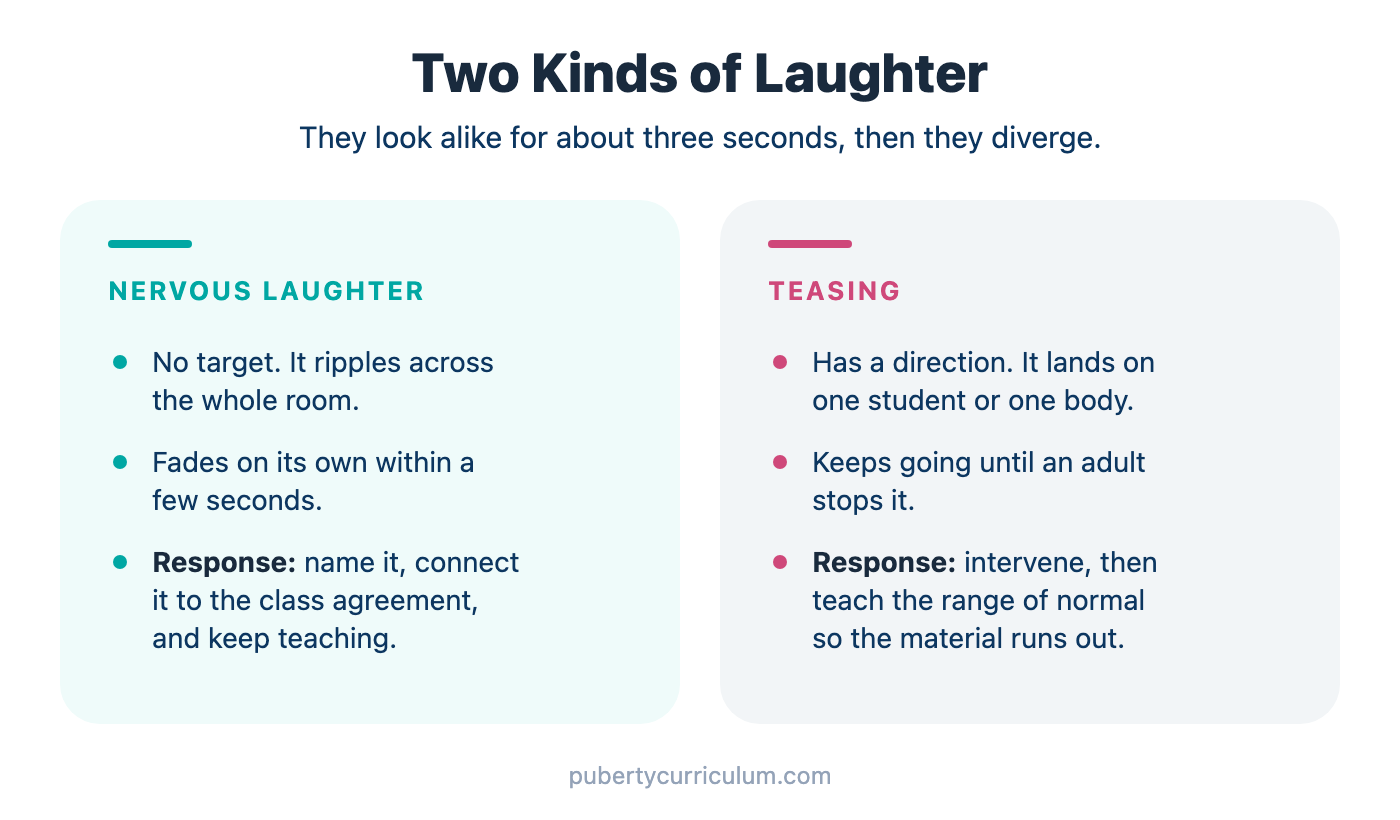
One distinction is worth making quickly. Nervous laughter has no target: it ripples across the room and dies on its own. Teasing has a direction, landing on a particular student, a particular body, a particular difference. The two can look identical for a moment, then diverge.
Trauma-informed design starts from the premise that you cannot see everything a student is carrying into the room. Adverse childhood experiences are common among young people, and a student who reacts loudly to a lesson about bodies may be managing something you have no way to know about. That is why the response to laughter should never be shame. Shaming a nervous student teaches everyone watching that reactions are unsafe here, and they stop asking real questions. What trauma-informed puberty education looks like in practice is a teacher who can absorb a reaction without punishing it.
Most of the Work Happens Before the First Lesson
Safety is the foundation of effective puberty education, and safety is built before instruction begins. In a well-designed curriculum, the first lesson of every grade level establishes community guidelines: a short set of agreements about how the class will treat each other and the material.
This is instructional work, not only classroom management. Building and holding a shared agreement exercises several competencies in the CASEL Social-Emotional Learning Framework, including self-management, social awareness, and relationship skills, which PWY integrates at grade 6. It also builds the environmental support factor in the adapted Health Belief Model.
Build the agreement with students rather than posting it at them. Students who help write it enforce it.
Two additions make those agreements do real work.
Name the laughter before it happens
Tell students plainly that some of this will feel awkward, that people laugh when they feel awkward, and that this is normal. Then agree together on what the class will do when it happens. Students who have already discussed the moment handle it better when it arrives.
Separate the reaction from the target
Teachers arrive at their own wording, but the principle is consistent.
Laughing at the awkwardness is fine. Laughing at a person is not.
That distinction gives you a fair, pre-agreed basis for intervening later. The time spent here pays back across the rest of the unit.
Six Things to Do in the Moment
When the giggling starts anyway, these responses de-escalate without stopping the lesson.
1. Name it and keep going. Acknowledge the laughter in one short sentence, connect it back to the agreement the class made, and continue. Stopping the lesson to address the laughter at length rewards it with attention and signals that the topic is as loaded as students suspected.
2. Do not single out the student who laughed first. Calling one student out converts a room-wide nervous reaction into a personal humiliation, and teaches everyone else to hide their discomfort.
3. Use the vocabulary more, not less. Correct anatomical terms lose their charge through repetition. Teachers who soften or skip the words confirm that they are shameful. There is a safety argument too: child sexual abuse prevention experts recommend teaching children the medical names of body parts as a protective factor, because a child who has the words can describe what happened to them.
4. Give the discomfort somewhere else to go. The Question Box methodology works partly as a classroom management tool. Every student writes something at the end of every lesson, a question or a comment, so participation itself never marks anyone out. Students who would otherwise perform their discomfort out loud have a private channel for it, and teachers answer selected questions at the start of the next lesson.
5. Change the social structure. Cooperative learning with assigned roles gives every student a job: leader, recorder, reporter, materials gatherer. A student with a defined task and something to report is not auditioning for the room.
6. Know the difference between discomfort and distress. The advice to keep the lesson moving applies to nervous laughter. It does not apply to a student who is shaking, crying, going blank and unresponsive, or leaving the room. In that case, stop rather than push through, offer the exit option, follow up privately, and connect the student with your school counselor. If a student discloses abuse, your job is to listen and report, not to investigate or promise secrecy; follow your district’s protocol and your obligations as a mandatory reporter.
Two adjustments are worth planning for. Neurodivergent students may laugh for reasons unrelated to embarrassment, and generally do better with explicit expectations stated in advance than with norms they must infer. Students from families with strong cultural or religious norms about discussing bodies may need the purpose of the lesson named directly, and so may their families.
The Design Choices That Prevent Most of It
If a room erupts every single lesson, the materials and the sequence deserve a look before the students do.
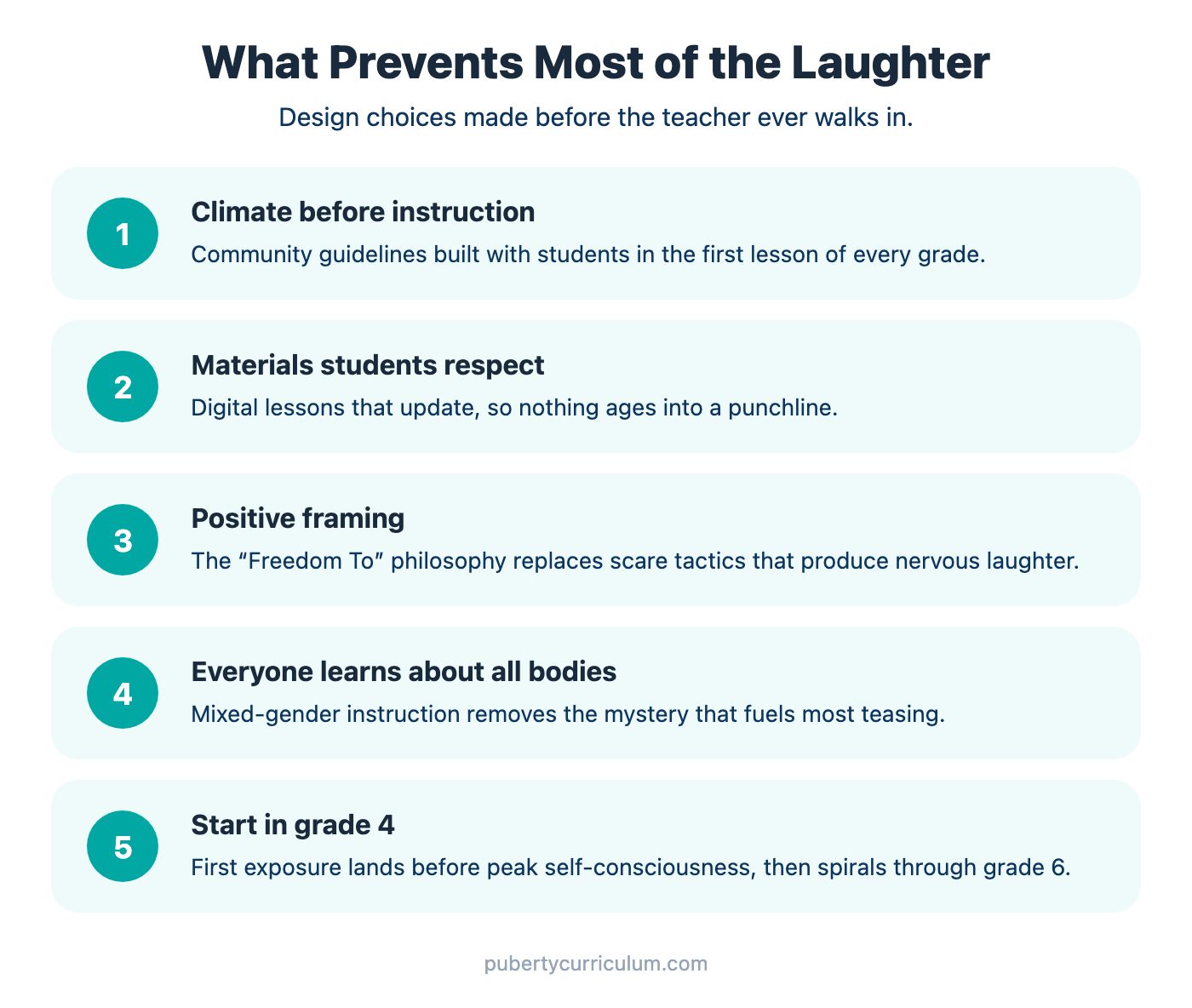
Materials students take seriously. “These lessons are older than dirt” is one of the most common complaints we hear. Students notice outdated materials before adults do, and dated language, clothing, and examples invite mockery.
Positive framing instead of fear. Fear-based puberty education tends to produce nervous laughter, because students laugh when they are frightened and have nowhere to put it. PWY’s “Freedom To” philosophy frames puberty around freedom to enjoy childhood, develop healthy relationships, reach goals, and make informed decisions. There is good reason to use positive framing rather than fear, and a calmer room is one of them.
Mixed-gender instruction. The default recommendation in PWY is teaching all students together, with guidance available for schools that require separate instruction. When everyone learns about all bodies, much of the mystery that fuels teasing goes away.
Starting early enough. Research on pubertal timing indicates that more than half of girls in the United States now show the first physical sign of puberty, usually breast development, before age ten, and that nearly half of American boys reach the first sign, testicular enlargement, by their tenth birthday. Beginning puberty is not the same as a first period, which typically arrives a couple of years later. Timing also varies with body weight and differs across racial and ethnic groups. The American Academy of Pediatrics publishes an overview of the usual range. A class meeting this material for the first time in late fifth or sixth grade meets it at peak self-consciousness. Starting in grade 4 and spiraling through grade 6 means the first exposure happens while students are still relatively relaxed about it.
Language that is medically accurate. PWY’s gender-inclusive language framework uses a “pattern, not rule” approach: most bodies follow common developmental patterns, and some do not, which describes real biological variation rather than a stylistic choice. Accurate language has a useful classroom effect too: it validates the majority experience without marking anyone as the exception.
When Laughter Turns Into Teasing
Sometimes the laughter finds a target. A student who developed early, a student who has not started yet, a student whose body does not match what the class expected.
Handle the incident directly, using the agreement the class already made. Then work out which kind of teasing you are dealing with.
Teasing from ignorance
A good deal of it runs on not knowing what is normal, and that kind responds well to instruction. Teach the range of normal clearly enough and the raw material for the joke stops existing.
Teasing for status
Some teasing is status behavior, and knowledge will not touch it. That kind needs a consistent behavioral response, documentation, and an administrator in the loop.
This is also where skills instruction earns its place. In a skills-based curriculum, students do not simply hear that teasing is unkind. Skills-Based Instruction moves every skill through four steps: explain, model, practice with feedback, and apply. At grade 6, PWY teaches structured frameworks for refusing unsafe or uncomfortable situations and for reporting interpersonal violence, and students practice them in the situations where they will need them. That design choice follows a long-standing finding in the field, and consistent with the 17 Characteristics of Effective Sex and STD/HIV Education Programs (Kirby, 2007): skills transfer poorly unless they are rehearsed in the relevant context.
What a Settled Classroom Actually Looks Like
A settled puberty classroom is rarely a silent one. Students still react. The difference is that the reactions stay proportionate and the lesson keeps moving.
Teachers describe a consistent arc. The first lesson is the loudest. Once students have tested whether the topic is safe and found that it is, they start asking what they genuinely want to know. Question Box submissions get more specific, and the joking drops away as the room stops being a place where puberty is a punchline.
Getting there depends less on classroom management technique than on the design of what you are teaching: whether it establishes climate before instruction, whether it gives students a private channel for hard questions, and whether the materials earn their respect.
If you would like to see how a curriculum built on those choices reads, you can look through the lessons yourself.