

You can see the need clearly. Research shows students are reaching puberty earlier than past generations. They are finding answers online whether or not the school provides better ones, and your teachers are asking for materials they can trust. What stands between that need and a working program is not the curriculum. It is the community, and the worry that introducing puberty education will divide families, fill your inbox, and end up at a board meeting.
That worry is reasonable. It is also, in our experience working with schools, almost always larger than the reality. The districts that roll out puberty education smoothly are rarely the ones in the most agreeable communities. They are the ones that treated the rollout as a partnership to be built, step by step, rather than an announcement to be survived. Here is how they do it.
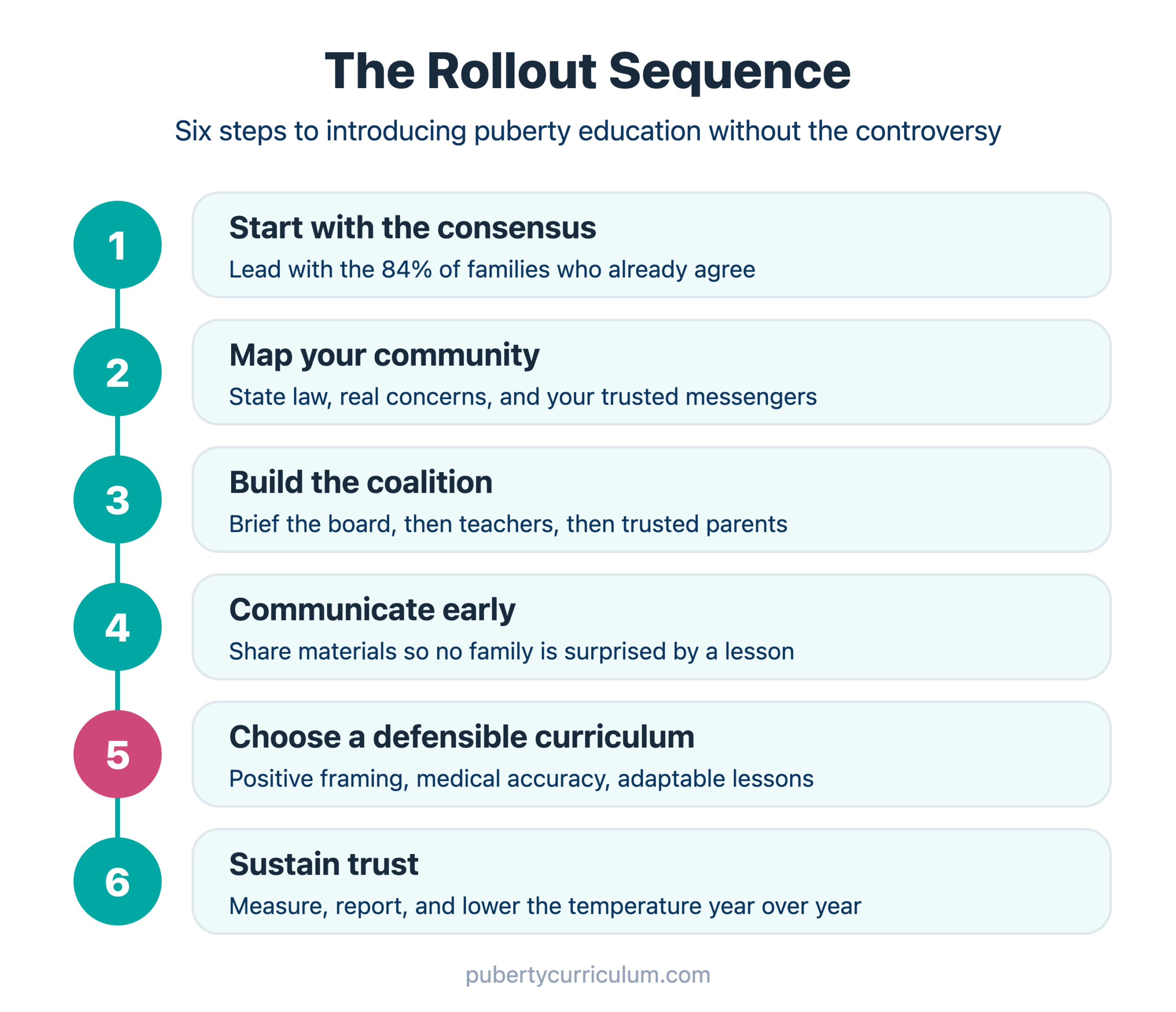
Start With the Consensus, Not the Noise
The first move is a mindset shift. When a sensitive topic comes up, the voices you hear first are the most intense ones, on every side. It is easy to mistake that volume for the position of your whole community. The data tells a calmer story. National surveys consistently find that more than 84% of parents support sex education in schools and want it to cover puberty, consent, and safety. The controversy is louder than the consensus, not bigger than it.
More than 84% of parents support sex education in schools. The controversy is louder than the consensus, not bigger than it.
Naming that shared goal early changes the conversation. Most parents, teachers, and board members want the same thing: children who are safe, informed, and respected. When you open with that common ground instead of a defensive posture, you frame the program as something the community is doing together, not something being done to it. Every later step in your rollout becomes easier when you have established, out loud, that you are starting from agreement.
Map Your Community Before You Choose a Curriculum
Before you select a program or set a date, spend time listening. A short assessment phase answers three questions that shape everything else.
First, what does your state actually require, and what does it restrict? Sex education law varies widely from state to state, and the landscape has been unusually active. In districts that had not previously prioritized the issue, recent federal funding disputes have prompted new board-level conversations about sex education policy. Knowing your legal footing before you begin keeps you from promising something you cannot deliver, or bracing for a fight that your state has already settled.
Second, which concerns in your community are real, and which are assumptions? You will not know until you ask. A sex education advisory committee, with parents, teachers, a school nurse, and a board member, is one of the most effective tools available. It surfaces worries while you can still address them in the design, and it turns potential critics into people who helped build the program. Third, who are your trusted messengers? Every community has parents and staff whose word carries weight, and identifying them now matters, because they will do more to build community buy-in for sex education than any letter you send.
| Question to answer first | Why it matters | Where to look |
|---|---|---|
| What does your state require and restrict? | Keeps you from over-promising or bracing for a fight your state has already settled. | State law and standards, district counsel, your state health education framework. |
| Which concerns are real, and which are assumed? | Lets you address worries in the program’s design, not after a complaint. | A sex education advisory committee: parents, teachers, a school nurse, a board member. |
| Who are your trusted messengers? | They build community buy-in faster than any letter you can send. | Parents and staff whose word already carries weight in your community. |
Build the Coalition Before You Announce
Sequence matters. The smoothest rollouts share information in concentric circles, starting with the people closest to the program and moving outward, so that by the time the wider community hears about it, informed and supportive voices are already in place.
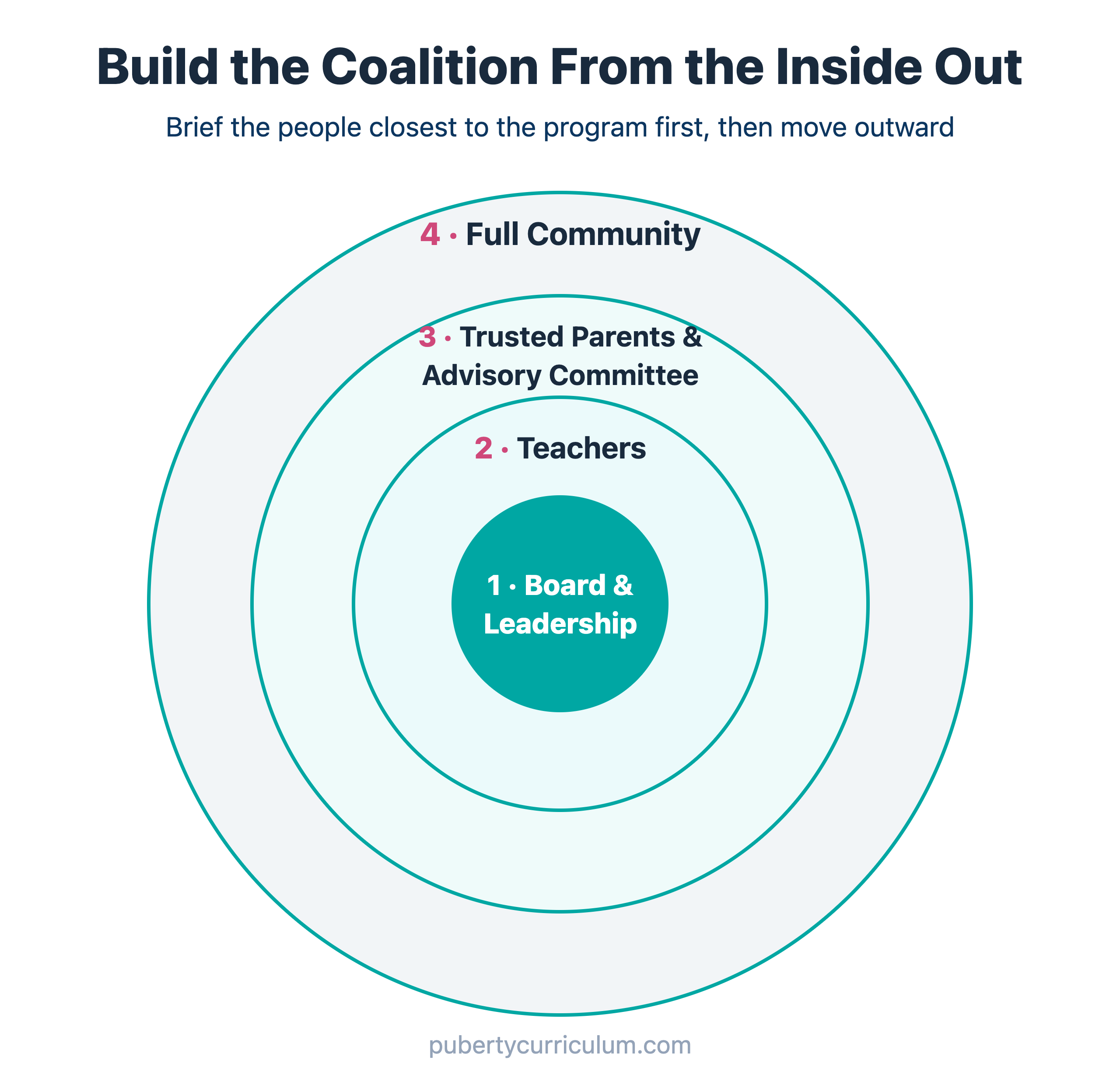
Start with your board and leadership, so no one is surprised at a public meeting. Bring in your teachers next, and take their anxiety seriously. The most common fear educators report about teaching puberty education is being asked a question they cannot answer, followed closely by the fear of saying the wrong thing and drawing a complaint. A curriculum built on Skills-Based Instruction, with word-for-word lesson scripts and a consistent four-step process of explain, model, practice, and apply, lowers that fear because the teacher is never improvising on a sensitive topic. When your teachers feel prepared, they become advocates rather than reluctant participants.
Only then do you widen the circle to your trusted parents and your advisory committee, and finally to the full community. By that point you are not making a cold announcement. You are confirming something many people already understand and support.
Communicate Early, Often, and in Both Directions
Most controversy grows in the gap between what a school is teaching and what parents imagine it is teaching. Close that gap and the ground for objection shrinks. The goal is simple: no family should ever be surprised by a lesson.
This is where a strong home-school partnership earns its keep, and where the right curriculum does much of the work for you. The infrastructure that prevents surprises includes a parent introduction letter that explains the program warmly, a curriculum outline that shows every lesson and topic, and a passive consent letter that gives families a genuine choice to opt out. Family Partnership Flyers tell parents what is being taught and how to continue the conversation at home, and a preview night invitation lets families review the materials and meet the teacher before the first lesson. When parents can see the curriculum for themselves, trust replaces suspicion. These same tools are the reason family engagement reduces opt-outs over time rather than driving them up.
The home-school partnership advantage: PWY treats family engagement as a design principle, not an add-on. A parent introduction letter, a curriculum outline, Family Partnership Flyers, a passive consent letter, and a preview night invitation come built in, in English and Spanish, so transparency is the default rather than one more task on your plate.
Communication also has to run in both directions. Give families a clear, low-friction way to ask questions and raise concerns, and answer them honestly. A parent who feels heard rarely becomes a parent who escalates. For the practical scripts and structures that keep small concerns from becoming complaints, our guide on how to prevent parent complaints before they start goes deeper.
Choose a Curriculum That Defends Itself
When the program lands in front of skeptical parents or a divided board, you want a curriculum that is easy to explain and easy to defend. Three qualities make that possible: positive framing, care for every student, and flexibility.
Easy to defend to a worried parent
- Positive “Freedom To” framing that celebrates growing up
- Age-appropriate, medically accurate content
- Materials families can preview in full
- An adaptable structure you tailor to your state
- Trauma-informed design, with no shaming or scare tactics
Harder to defend
- Fear-based framing built on warnings and worst cases
- One-size-fits-all content with no local flexibility
- Materials families never see until a lesson surprises them
- Few or no family communication tools
- An improvised approach to sensitive student questions
PWY is built on a “Freedom To” philosophy: freedom to enjoy childhood, to develop healthy relationships, to make informed decisions. That framing celebrates growing up rather than scaring students about it, and a positive, age-appropriate program is far simpler to defend to a worried parent than one that relies on fear. Trauma-informed design, with content warnings before sensitive topics, guidance for teachers handling emotional moments, and no shaming or scare tactics, reassures families that the classroom will be safe. The Question Box methodology, where students submit questions and teachers prepare thoughtful answers between lessons, shows parents that every question is handled with intention rather than improvised on the spot.
Flexibility completes the picture. A program with an adaptable structure lets you select the lessons that fit your community and your state requirements, including optional lessons schools can add based on local needs. Medical accuracy and alignment to the National Sex Education Standards give curriculum directors the evidence base they need to recommend it with confidence. If you are still in the selection phase, our framework for how to evaluate and choose a puberty curriculum walks through the criteria that matter most.
Sustain Trust After the First Year
A careful rollout is not a one-time event. The quiet first year is what builds the credibility that makes every following year easier. Keep families informed through newsletter articles and ongoing communication, use pre and post tests and implementation logs to show that students are learning, and report those results to your board and community.
Each year of calm, transparent instruction lowers the temperature a little more. Opt-outs tend to fall as trust grows, complaints become rare, and the program shifts from something the district has to defend into something the community is proud of. That is the real measure of a successful introduction: not the absence of any concern in year one, but a partnership strong enough that puberty education simply becomes part of how your school cares for its students.
Build the Trust, in the Right Order
Introducing puberty education to a hesitant community is a project of trust, built in the right order. Start from the consensus, listen before you launch, communicate so no family is surprised, and choose a program that defends itself. Do that, and the rollout you were dreading becomes one of the clearer wins on your desk.
If you would like to see what a community-ready curriculum looks like before you commit, request a free curriculum preview of Puberty: The Wonder Years and review every lesson, family communication tool, and teacher script for yourself.