
Most schools build their puberty education rollout around family communication: a notification letter, a preview night invitation, a curriculum outline, and activity sheets that go home for a parent signature. On paper, the home-school partnership is covered.
Then the forms come back, and a pattern appears. The families who did not respond, or who opted out without saying why, are often the families who never received anything they could read.
In our work with schools, this is one of the most common blind spots in an otherwise careful rollout, and it is rarely a question of will. A district that has translated its enrollment packet and field trip forms may simply never have looked at the puberty unit the same way, because the unit arrived as a curriculum rather than a communication plan.
The Families Most Likely to Miss the Message
The scale is larger than most rollout plans assume. According to the National Center for Education Statistics, 5.3 million students, about 10.6 percent of US public school students, were English learners in fall 2021, the most recent year with published national figures. Spanish was the home language for 4.0 million of them, roughly 76 percent of all English learners.
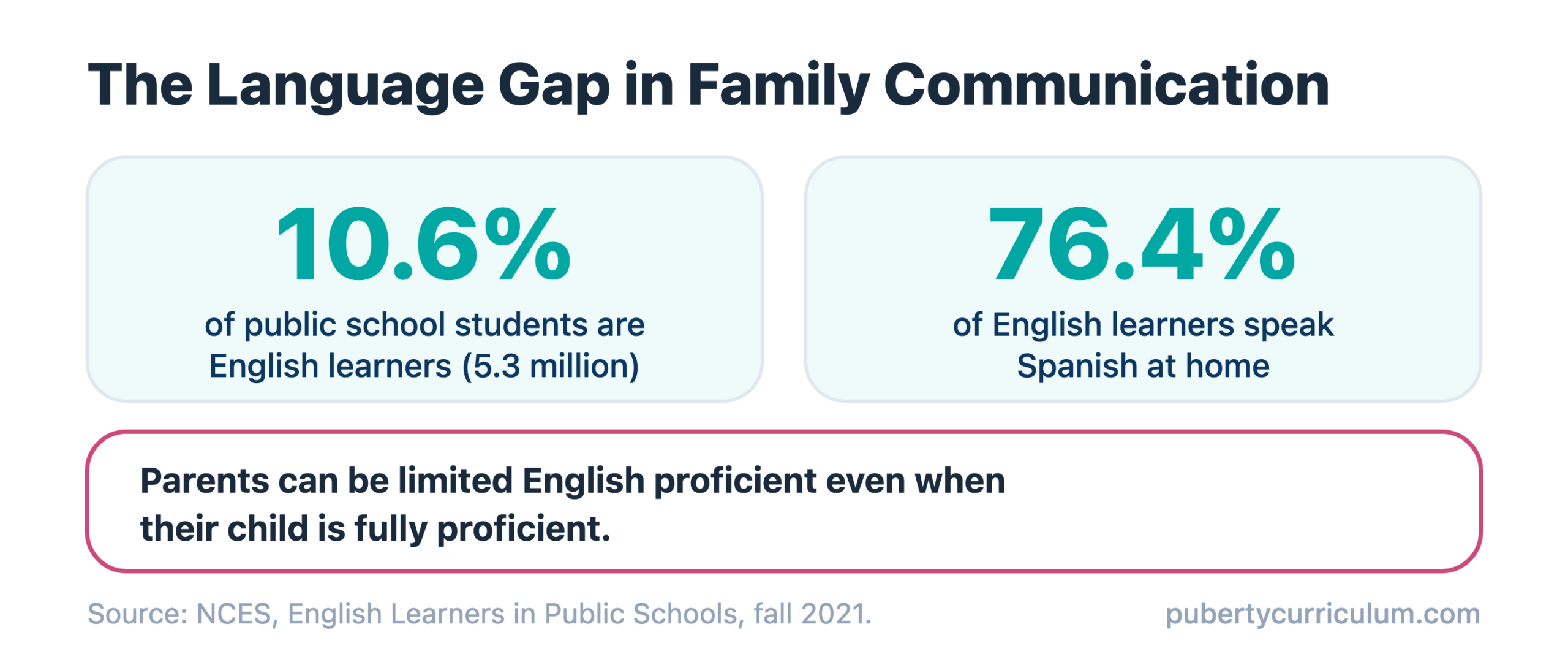
There is a second number that appears on no roster, and it matters most here. The Department of Education’s Office for Civil Rights is direct about it: parents can be limited English proficient even when their child is proficient in English. A fifth grader who tests out of English learner services may still go home to a household where the adults read Spanish.
This is why sizing language need from the English learner roster undercounts it. The roster describes students. Puberty education asks you to reach the adults.
In Puberty Education, the Family Materials Are Part of the Instruction
In many subjects, family communication is a courtesy. Here it is part of the instructional design.
Puberty: The Wonder Years is built on an adapted Health Belief Model, which holds that four factors have to be present for students to develop healthy behavior: knowledge, self-efficacy, skills, and environmental support. That fourth factor draws on families, schools, and communities together, the reinforcement that tells a student the things they learned in class are real and worth acting on. It is the reason knowledge alone does not change behavior when a curriculum only delivers information.
When the family-facing materials exist only in English, the school strand keeps working. The classroom climate holds, the teacher reinforces the lessons. What stops working is the school’s half of the family strand, the structured conversation the design is counting on, because the conversations that carry a puberty lesson forward happen with a trusted adult at home rather than in a 50-minute period.
The support you need is already there. A meta-analysis of 23 US surveys fielded between 2000 and 2016, published in the Journal of Adolescent Health, found that 90 percent of respondents in parent-focused surveys supported sexual health education in schools. Broad agreement is not the obstacle. Agreement cannot become participation if the invitation arrives in a language the household does not read.
Your Notification Letter Is a Civil Rights Document
This is worth stating plainly, because many districts treat the puberty unit’s paperwork as informal correspondence when it is not.
Title VI of the Civil Rights Act, which the Supreme Court applied to language access in Lau v. Nichols, requires schools, per joint Department of Justice and Department of Education guidance, to communicate with limited-English-proficient parents, in a language they can understand, about any program, service, or activity called to the attention of parents who are proficient in English. The fact sheet lists covered communications explicitly, and “requests for parent permission for student participation in school activities” is on that list. A puberty unit’s notification letter and opt-out form sit squarely inside it.
One clarification on terminology. A parental notification with passive consent, often called an opt-out form, lets a student participate unless a parent objects. An opt-in policy reverses that: no signature, no participation.
Adequate language access
- Documents translated into the languages families actually read
- Qualified interpreters arranged in advance, free to families
- A named contact who can respond in the family’s language
- Information shared at the same time English-speaking families receive it
Not adequate
- Asking a student to interpret for their own parent
- A sibling or family friend translating a consent form
- Untrained bilingual staff pressed into service
- Translated documents that arrive after the unit has started
Federal guidance is also specific about who may interpret. Asked whether a school may ask a child, other students, or untrained staff to translate for a parent, the fact sheet answers no: schools must use appropriate and competent individuals and may not rely on students, siblings, friends, or untrained school staff. The instinct to ask a bilingual fifth grader to explain a puberty consent form to their own parent is understandable in a busy building. It is the arrangement the guidance rules out, and it puts a child in an impossible position.
The guidance draws one more line. A bilingual staff member can be the person a parent calls with a question, but it is not sufficient for staff merely to be bilingual, because interpreting accurately and translating documents are trained skills. Language assistance also has to be free to families, which forecloses asking a parent to bring an interpreter.
There is an accuracy reason as well as a compliance one. Researchers analyzing interpreted pediatric visits for Annals of Emergency Medicine found 22 percent of errors by ad hoc interpreters carried potential clinical consequences, against 12 percent for trained professionals. That research comes from healthcare, but the mechanism travels: an untrained interpreter handling unfamiliar anatomical vocabulary makes more consequential mistakes.
The stakes rise in states moving toward opt-in requirements. As covered in our guidance on how family engagement reduces opt-outs, we have consistently found that non-participation traces back to unanswered communication more often than to firm objection. Under an opt-in policy, a consent form a parent cannot read produces the same result as a refusal.
One scoping note: Title VI is language-agnostic, so a district serving Arabic, Vietnamese, or Haitian Creole speaking households carries the same obligation, and Spanish materials alone will not discharge it.
Translation Is the Floor
Translated documents are necessary. The research is clear they are not sufficient on their own.
Reviews of the evidence on English learner family involvement find these families are considerably less likely to attend school events or serve on committees, and that the obstacles are practical and relational as much as linguistic. Work schedules, transportation, childcare, and prior experiences of not being welcomed all shape whether a parent walks into the building. A translated flyer does not resolve that.
Two things are easy to miss. Literacy in the home language varies, so a family who cannot use an English document may not manage a Spanish one either, which makes spoken interpretation part of the plan rather than an extra. And home-language access is one dimension of culturally responsive practice rather than the whole of it, not a substitute for knowing the community you serve.
It also helps to remember what these families bring. Many parents who speak Spanish at home are already talking with their children about growing up, hold the deepest expertise about their own child, carry their own values about when and how, and are often connected through community networks that reach further than any school mailing. The best version of this work treats them as partners rather than a population to be notified.
For a puberty unit specifically, a few additions do most of the work:
- Qualified interpretation at the preview night, arranged in advance rather than at the door
- A session time that accommodates shift work, or a recorded walkthrough
- A named person who can answer questions in the family’s language, and a way to reach them
- Bilingual staff or community liaisons involved while the rollout is being planned, not after a complaint
That last point is the principle behind introducing puberty education to a hesitant community. Trust is built before the announcement, not after.
The home-school partnership only exists in the languages the home actually speaks.
What Bilingual Family Materials Look Like in Practice
A curriculum can carry much of this when its family-facing materials were designed bilingual rather than translated by each district under deadline.
In PWY, the family tools documented as available in both English and Spanish include the parent introduction letter, the Family Partnership Flyers, the Family Activity Sheets that require a parent or trusted adult signature, and parent and caregiver blog content. The teacher-facing curriculum is in English; the family layer is largely bilingual, which is the layer this problem lives in.
| Family-facing material | Documented in Spanish | What it does |
|---|---|---|
| Parent introduction letter | Yes | Introduces the program before lessons begin |
| Family Partnership Flyers | Yes | Explains what is being taught, with conversation tips |
| Family Activity Sheets | Yes | Structured at-home conversation, returned with a signature |
| Parent and caregiver blog content | Yes | Ongoing answers to common family questions |
| Notification and passive consent letter | Not documented; confirm directly | Governs whether a student participates |
The Family Activity Sheets matter most here. Because they call for a signature from a parent or any trusted adult, families decide who has the conversation, and in a Spanish-speaking household it happens in Spanish. That produces a documented conversation rather than a flyer that may or may not be read.
The Question Box methodology works from the other direction. Every student writes a question or comment at the end of every lesson and teachers prepare answers before the next one, drawing on the curriculum’s appendices of model answers, so questions surface without a student having to raise a hand. Worth planning for: an English learner will typically write those entries in English, so read them generously.
Ask for this: The list of which specific family documents a publisher supplies in Spanish, rather than a general assurance. PWY does supply a parental notification and passive consent letter, though its documentation does not list that letter among the Spanish materials, so confirm it directly.
A Language Access Check for Your Puberty Unit
Five checks, each of which can be completed before the unit begins.
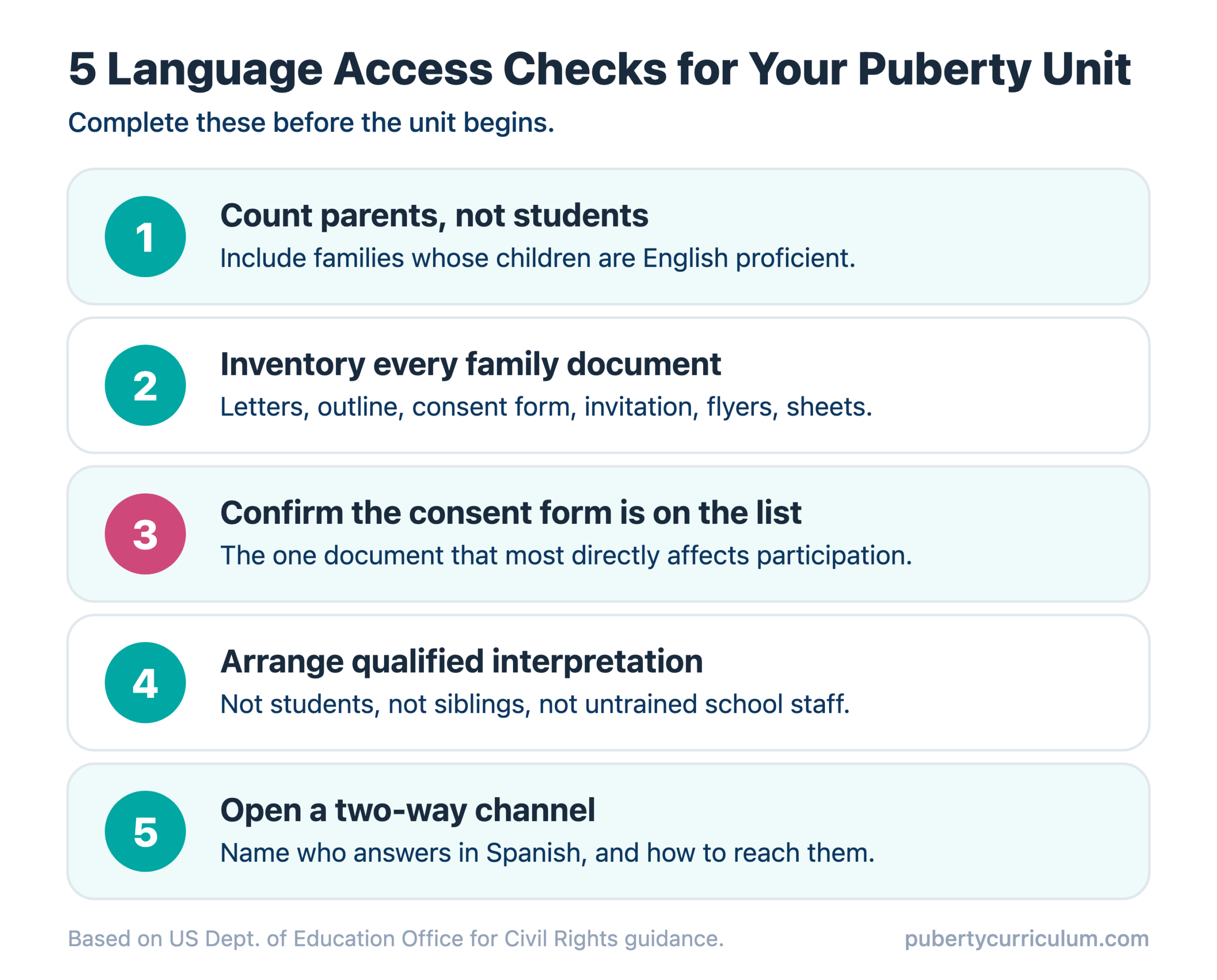
- Count parents, not students, then ask them. Start from the Home Language Survey collected at enrollment and your student information system’s communication-preference field, including families whose children are English proficient. Then have a few of those parents read your draft letter.
- Inventory every family-facing document in the unit. The introduction letter, curriculum outline, notification and consent form, preview night invitation, flyers, and activity sheets.
- Confirm the consent form is on the translated list. It carries the most direct consequence for participation, and because it is often a district legal document rather than a publisher’s, translating it is usually your responsibility.
- Arrange qualified interpretation for the preview night, in each home language your survey identifies. Not students, not siblings, not untrained staff.
- Open a two-way channel. Name the person a family can ask a question of in their own language, and say how to reach them.
None of this requires a new initiative, only running your family engagement plan through one more filter before the unit starts. For a subject where family reinforcement is part of the instructional model, that filter is part of teaching the unit well.
To see how the family engagement materials are structured, including the bilingual parent letters, Family Partnership Flyers, and Family Activity Sheets, you can request a free curriculum preview and review them alongside the lessons they support.