

Somewhere in your district right now, a parent is scrolling through a Facebook group and reading a secondhand, half-accurate account of what the puberty education program is going to teach their child. By the time that post reaches you, you’re no longer introducing a curriculum. You’re defending one.
This is the scenario administrators dread most about sex education: not the curriculum itself, but losing control of the story before they’ve had a chance to tell it. The fix isn’t complicated, though it does take intention. It’s a parent preview night, held before lessons begin, where families see what’s being taught, in detail, and have a chance to ask questions in person.
Why the First Conversation Shouldn’t Happen Without You
Parents rarely object to puberty education itself. Most support it. What triggers opposition is almost always the same handful of things: hearing about the curriculum from another parent instead of the school, feeling excluded from the decision, or encountering a topic they didn’t expect and weren’t prepared for.
A preview night addresses all three at once. It puts the school, not a rumor, in charge of the first impression. It gives families a seat at the table before anything is taught, not after a complaint has already been filed. And it removes the element of surprise that turns a manageable question into a viral post.
Administrators sometimes treat this as one more item on an already full plate. It’s worth reframing.
A parent preview night is the single highest-leverage hour you’ll spend on the puberty education program all year.
That’s because it’s the hour that prevents most of the phone calls, emails, and board meeting comments that would otherwise follow.
What Belongs on the Agenda
You don’t need to build this from scratch. If you’re using PWY, most of the material already exists; the preview night is where you present it in person instead of sending it home in an envelope.
Start with the curriculum outline, which lists every lesson and topic taught at each grade level. Walk through it section by section rather than handing it out and moving on. Parents and caregivers want to see specifics, not a summary. Explain the parental notification and passive consent letter and what it means in practice: families are informed in advance, and any parent who wants to opt their child out can do so.
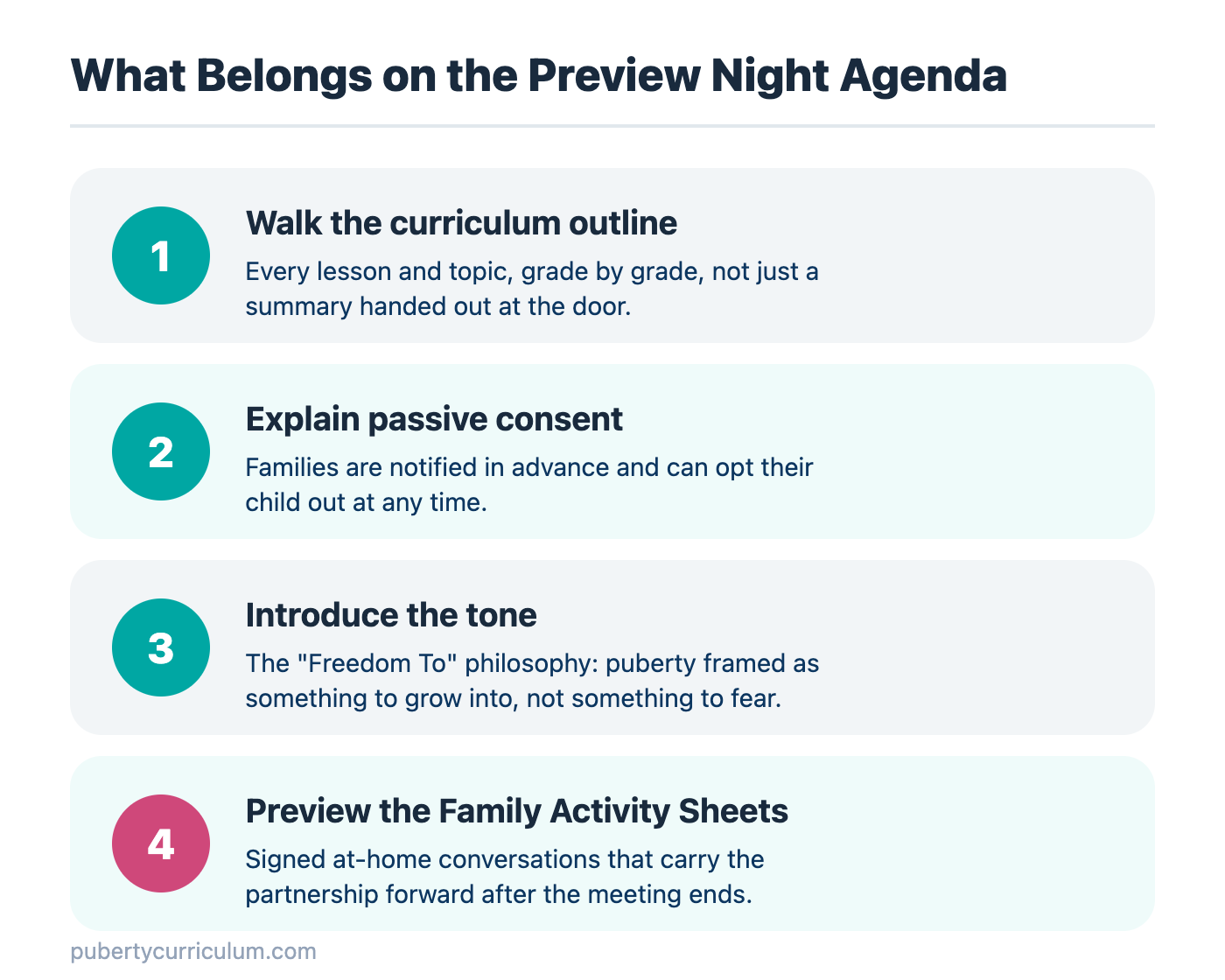
This is also the moment to explain the tone of the curriculum, not just its content. PWY is built around what’s called the “Freedom To” philosophy: instead of framing puberty as something to fear (freedom from pregnancy, freedom from risk), the curriculum frames it as something to grow into (freedom to enjoy childhood, build healthy relationships, and make informed decisions).
Say it out loud in the room: parents who are bracing for a fear-based, worst-case-scenario approach are often relieved to hear the actual framing is closer to the opposite.
Close the agenda portion by previewing the Family Activity Sheets families will see come home over the course of the unit. You don’t need to reveal the specific content of any individual activity. What matters is that families understand these sheets require their signature and are designed to start a conversation at home, not replace one.
Writing the Invitation So Families Actually Show Up
The meeting only works if people attend, and attendance starts with the invitation. A cold, formal notice reading like a compliance document will get skimmed and ignored. A warm one, written like it’s from a person who has actually thought about the parent’s perspective, gets read.
Lead with what the parent will get out of attending, not with what the school needs from them. Most parents who are anxious about this topic aren’t anxious because they oppose the content. They’re anxious because they don’t know what to expect and don’t know how to start the conversation themselves. Say that directly: this is a chance to see what’s being taught, in full, ask questions, and leave with tools to keep the conversation going at home.
Keep the invitation specific. Name the date, the format, and roughly how long it will take. Mention that materials will be available in English and Spanish. If there’s a way to attend virtually for families who can’t make it in person, say so. Every barrier you remove is one more parent who shows up informed instead of forming an opinion from a rumor.
Handling the Room When Someone Pushes Back
Even with a well-run night, someone may push back. That’s a normal part of the process, and what matters most is how the room is handled.
The tone that works here is calm and bridge-building, not defensive. Most parents in the room, including the ones with concerns, want the same thing you want: kids who are safe, informed, and treated with respect. Say that plainly if the temperature in the room rises. It’s true, and it resets the conversation from adversarial to collaborative.
It also helps to walk in with a few grounded facts rather than winging it. More than 84 percent of parents support sex education in schools, including instruction on puberty, consent, and safety. Comprehensive, inclusive sex education is endorsed by the American Academy of Pediatrics, the American Medical Association, and the Society for Adolescent Health and Medicine.
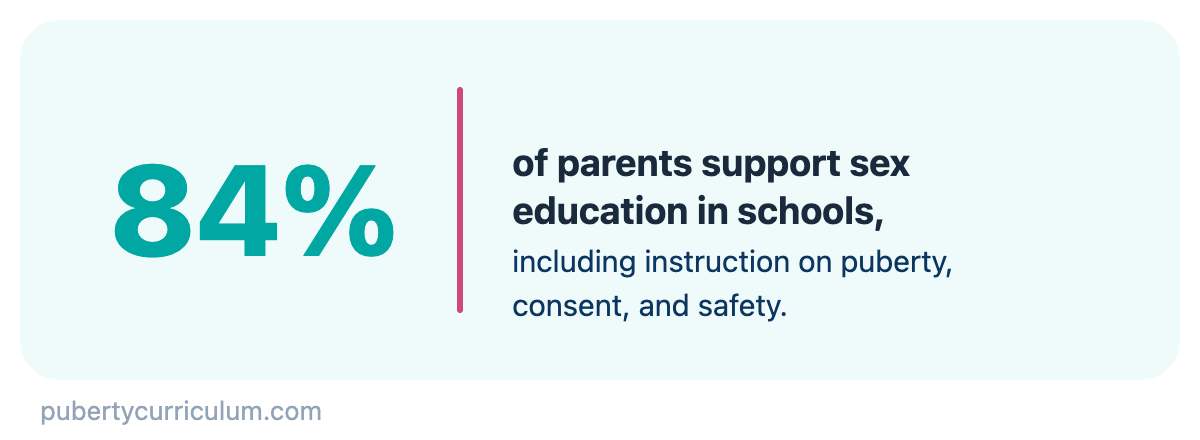
You’re aligned with the consensus of parents and professional medical organizations, even if the loudest voice in the room doesn’t reflect that.
If a specific concern comes up that you can’t fully resolve on the spot, don’t improvise an answer you’re not sure of. Acknowledge the question, thank the parent for raising it, and follow up individually afterward. A promised follow-up handled well builds more trust than a rushed answer handled poorly.
Making the Night the Start of a Partnership, Not the End of One
The preview night does the most good when it’s treated as the opening move in an ongoing relationship, not a box to check before lessons start. The same tools that made the meeting substantive keep working long after it ends.
Family Partnership Flyers go home before each major topic, giving parents a heads-up and a few conversation starters. Family Activity Sheets keep the conversation active throughout the unit. A Parent Resources website gives families somewhere to go at 9 p.m. when their child asks a question they didn’t expect. None of this requires reinventing anything for each family; it’s the infrastructure that already exists to support the home-school partnership PWY is built around.
There’s a reason this infrastructure works: family engagement is one of four factors in PWY’s adapted Health Belief Model, alongside knowledge, self-efficacy, and skills. It’s called Environmental Support, the reinforcement students get from families and communities, and a preview night is where that factor starts to take shape.
What a Skeptical Parent Needs to Hear
- You’ll know what’s being taught before it’s taught
- You can preview every lesson and topic in the curriculum outline
- Opting out is a real, respected choice
What an Engaged Parent Needs to Hear
- You’ll get tools to keep the conversation going at home
- Materials are ready to use, not something you have to create yourself
- Your questions get a real answer, not a form letter
Schools that treat family engagement as an ongoing practice, not a single event, tend to see family engagement tools reduce opt-outs over time, because trust compounds. Each well-handled touchpoint makes the next one easier. That’s also the difference between introducing a new program to a hesitant community that stays hesitant, and one that gradually becomes supportive.
A parent preview night is a small investment of time that pays off across the entire school year, and often across every year the program runs after that. It’s one of the most effective ways of preventing parent complaints before they start, because it replaces uncertainty with information before anyone has a reason to be upset.
If you’re planning your first preview night and want to see everything you’ll be walking families through, you can request a free curriculum preview and review the materials yourself before you present them to your community.