
If you sit on a curriculum selection committee, you already know the drill. Every subject that isn’t tested has to earn its place on the schedule twice: once by proving it teaches something valuable, and again by proving it doesn’t crowd out something else. Health education carries that burden every year. So does social-emotional learning. Ask a principal to defend twenty minutes for puberty education and a separate block for SEL instruction, and watch the schedule negotiation get uncomfortable fast.
Here is the case we have made to selection committees for years, and it still holds: those minutes are not competing with each other. When puberty education is built the way it should be, it already functions as social-emotional learning. The overlap is structural, not a marketing angle, and it is worth understanding in detail before your next adoption conversation.
Puberty education and social-emotional learning are not two departments competing for classroom minutes. Done well, they are one.
Why SEL and Puberty Education Keep Landing on the Same Priority List
The two subjects share a fate for a simple reason. Neither appears on a standardized test, so both depend on someone in the building making a values-based argument for the time they take. Social-emotional learning has gained ground because districts can point to research linking SEL skills to behavior, attendance and school climate. Puberty education faces the opposite pressure. It gets treated as optional, controversial or a scheduling afterthought, even though the research on skills-focused, inclusive sex education points toward similar outcomes: better body image, more empathy, improved communication, and a stronger sense of self-control and safety.
That shared research base is the opening. If a curriculum can demonstrate that it builds SEL competencies while it teaches puberty content, it stops being two separate arguments for instructional time. It becomes one.
This matters just as much for the teacher standing in front of the classroom as it does for the committee approving the purchase order. A teacher who can tell a principal that today’s lesson also builds SEL competencies is making the same time-justification case at the classroom level that a curriculum director makes at the district level.
What the CASEL Framework Looks Like Inside a Puberty Lesson
CASEL’s five competencies, self-awareness, self-management, social awareness, relationship skills and responsible decision-making, are the common language most SEL specialists use to evaluate any program, regardless of subject. Puberty education maps onto them with almost no translation required. A lesson on the physical and emotional changes of puberty is, by definition, an exercise in self-awareness. A lesson on managing the mood swings and anxiety that come with hormonal shifts is self-management. A unit on healthy versus unhealthy relationships is relationship skills. A discussion of how to evaluate a choice, weigh its consequences and decide what to do next is responsible decision-making.
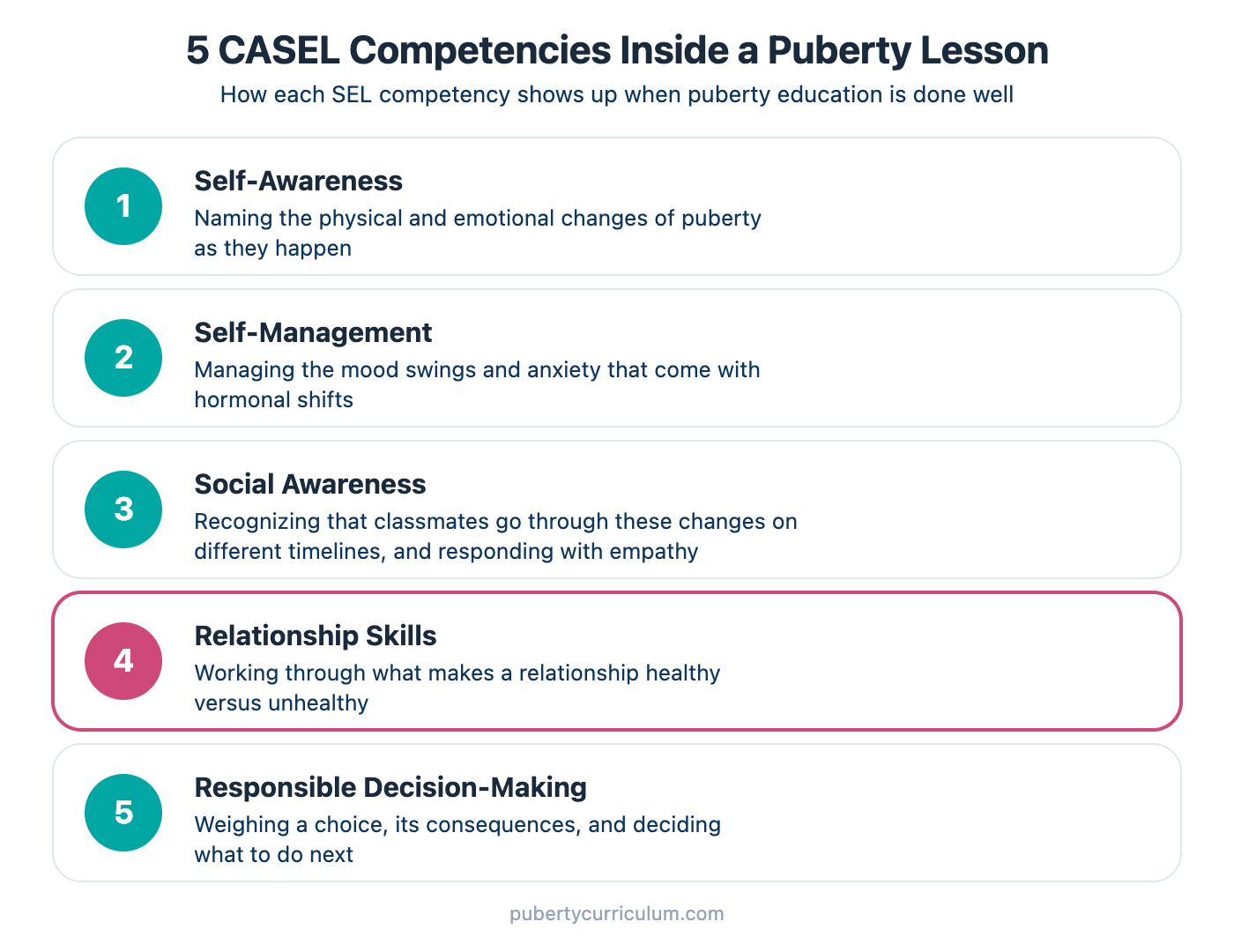
PWY builds this alignment in explicitly rather than leaving it to interpretation. Grade 6 integrates the CASEL Social-Emotional Learning Framework directly into lessons on brain development, emotional regulation, healthy relationships and future planning, alongside PWY’s full scope and sequence for grades 4 through 6. For a curriculum director building a case to a selection committee, that is a specific, documented alignment to point to, not an inference someone has to make on their own.
Knowledge Alone Doesn’t Build Emotional Skills, and It Doesn’t Change Behavior Either
SEL practitioners learned this lesson early: teaching a student to name an emotion does not mean the student can regulate it under pressure. Naming is knowledge. Regulating is a skill, and skills require practice, feedback and a supportive environment before they take hold. Puberty education runs on identical logic, and that logic has a name in PWY’s design: the adapted Health Belief Model.
PWY’s version of the model targets four factors in every lesson: knowledge, self-efficacy, skills and environmental support. A student can memorize the stages of puberty and still freeze in the moment they need to set a boundary or ask for help. Self-efficacy, the confidence that comes from believing they can act on what they know, has to be built alongside the facts. So do the underlying skills themselves: communication, refusal, decision-making, help-seeking. None of it holds without environmental support, the reinforcement students receive from teachers, families and peers once the lesson is over.
Adapted Health Belief Model: knowledge, self-efficacy, skills, and environmental support. PWY builds all four into every lesson, not knowledge alone.
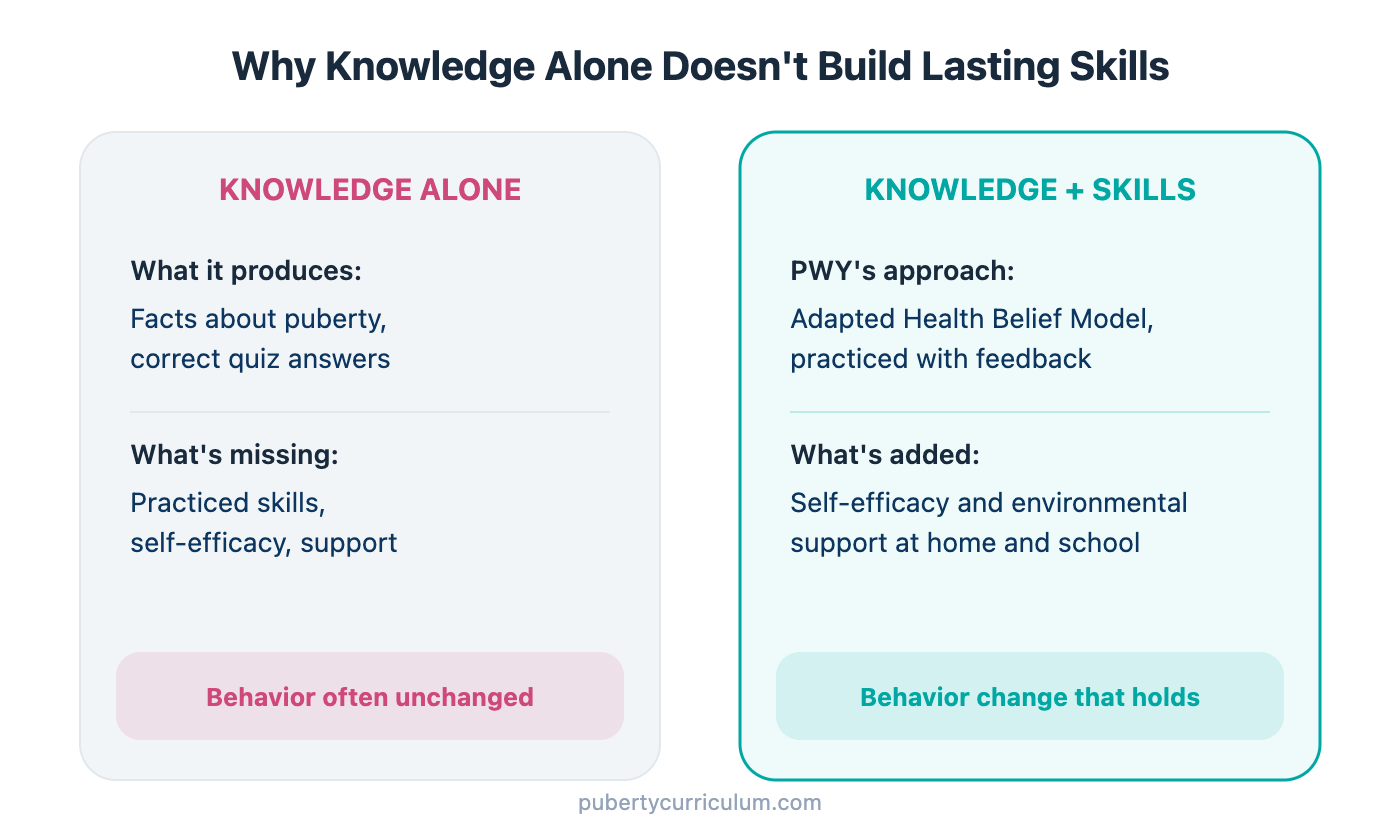
This is the same behavioral logic SEL researchers use to argue against knowledge-only programs. A curriculum director who already understands why SEL requires more than information has a head start on understanding why puberty education does too. It is one argument, made twice, in two different departments.
Practicing the Skills, Not Just Naming Them
Responsible decision-making and relationship skills, two of the five CASEL competencies, are performance skills. They show up under pressure, in real interactions, not on a quiz. That is what PWY’s Skills-Based Instruction model is built to teach. Every skill in the curriculum moves through the same four steps: the teacher explains why the skill matters, models what it looks like, gives students a chance to practice it with feedback, then has them apply it to a situation that resembles what they might actually face.
Cooperative learning reinforces the same competencies from a different angle. PWY structures group work with assigned roles, such as leader, recorder, reporter and materials gatherer, rather than leaving it open-ended. Assigned roles mean every student has a job, which builds communication and collaboration at the same time the group works through health content. For a teacher already asked to fit SEL instruction somewhere into a crowded day, that overlap is not a coincidence. It is the design.
| CASEL Competency | Built Through |
|---|---|
| Responsible decision-making | Skills-Based Instruction’s 4-step model: explain, model, practice, apply |
| Relationship skills | Skills-Based Instruction applied to realistic peer scenarios |
| Social awareness and collaboration | Cooperative learning roles: leader, recorder, reporter, materials gatherer |
This is also where the argument becomes easier to defend to a skeptical parent or board member. A skills practice activity that looks, on the surface, like a puberty lesson is doing double duty: building the same relationship and collaboration skills a stand-alone SEL block would target, without asking for additional minutes in the schedule.
Emotional Safety Is a Precondition for Both
Every SEL framework rests on one precondition: students need to feel safe before they can be self-aware, regulate their emotions or take a social risk like asking a question in front of peers. A classroom that runs on fear or shame will not produce the outcomes either program promises, no matter how well the lesson plan is written.
This is where trauma-informed design and the “Freedom To” philosophy earn their place in the conversation. Trauma-informed design means content warnings before sensitive topics, Teacher Tips for handling emotional reactions in real time, and built-in exit options so a student who needs a moment can take one without drawing attention. The “Freedom To” philosophy replaces fear-based framing, freedom from pregnancy, freedom from disease, with a positive one: freedom to enjoy childhood, build healthy relationships and make informed decisions. Neither of these is a soft add-on. They are the conditions that make the rest of the SEL argument credible. A curriculum can claim CASEL alignment on paper, but if the classroom climate undermines safety, the alignment will not survive contact with real students.
Without Emotional Safety
- Students stay quiet rather than risk embarrassment in front of peers
- Self-awareness and reflection shut down under shame
- CASEL competencies stay theoretical, not practiced
With Trauma-Informed Design
- Content warnings signal what’s coming before sensitive topics
- Built-in exit options reduce pressure to perform composure
- “Freedom To” framing replaces fear-based warnings with respect
Bringing the SEL Case to Your Selection Committee
If you are building a recommendation for a committee that includes an SEL coordinator, a health teacher and a board member worried about instructional minutes, this overlap is worth stating plainly rather than leaving it implicit. Point to the specific competency-to-lesson mapping. Point to the behavioral science framework behind the skills instruction. Point to the fact that the curriculum treats emotional safety as infrastructure, not an afterthought.
The most reliable way to see whether a curriculum delivers on this alignment, rather than simply claiming it, is to look at the lessons directly. Request a free preview of PWY’s grades 4 through 6 curriculum and see how the CASEL competencies, the Health Belief Model and the Skills-Based Instruction model show up lesson by lesson, not just in a marketing summary.