

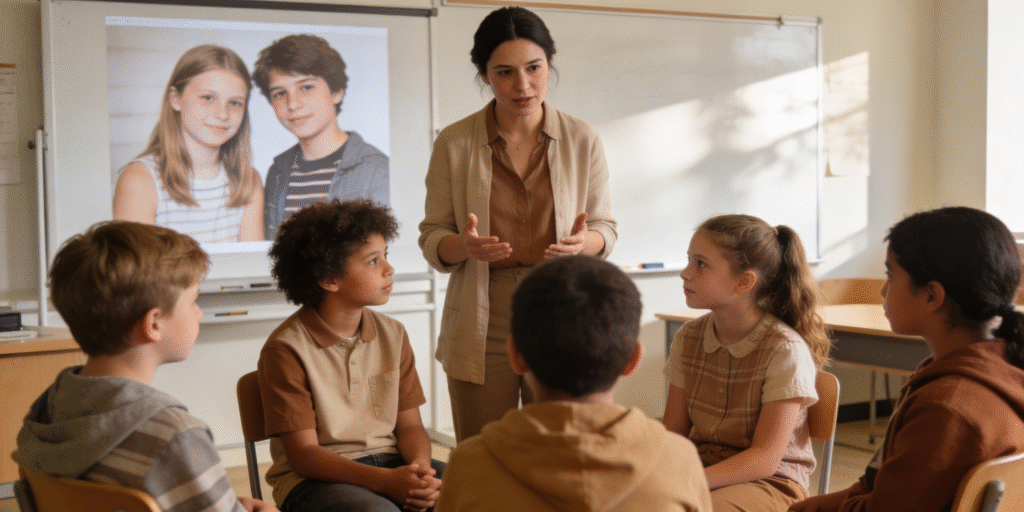
That feeling in the pit of your stomach when you know a tough topic is next in your lesson plan? As an educator who has been in the trenches for over 35 years, I know that feeling well. It’s completely normal, especially when the subject is body image. It’s what experts call a ‘crucial conversation,’ where emotions run high and the stakes feel enormous. But here’s the challenge I see schools facing every day: with more than half (57.2%) of young people saying social media makes them dissatisfied with their bodies, and with 80% of kids as young as 8 already on these platforms, this conversation is already happening. It’s happening in their minds and on their phones. This guide is here to help you step in and lead it safely and confidently.
The conversation you’re worried about (and why you can’t avoid it)
Many of us feel unprepared to navigate these discussions. Teachers often express nervousness about saying the wrong thing, and understandably so—we aren’t trained counselors, and that fear can be paralyzing. It’s tempting to hope someone else, like a parent or a specialist, is handling it.
The reality, however, is that our students are often navigating this complex world alone. The same research that highlights their dissatisfaction also reveals a troubling silence: over 73% of young people “never” or “rarely” talk to someone when social media makes them feel bad about their body. They scroll, they compare, and they internalize—often without the tools to process what they’re seeing.
This is where you come in. Your classroom can be the one place where students are given permission to question the digital world and are equipped with the skills to think critically about it. You don’t need to have all the answers. You just need a safe framework to start the conversation.
Your 3-step framework for a safe and structured discussion
Think of this not as adding “health expert” to your job description, but as facilitating a vital media literacy lesson. I’ve found this simple, three-step approach helps protect both your students and you by creating a structured space for exploration without getting into sensitive personal territory.
Step 1: Set the stage before you say a word
In my experience, the most important part of this conversation happens before it even begins. A safe environment is non-negotiable. Before you dive into the topic, invest time in creating a container of trust.
First, I always recommend establishing clear ground rules together. These are your classroom norms for any sensitive topic. They might include principles like, “We listen to understand, not to judge,” “We respect each other’s privacy,” and “It’s okay to have different perspectives.” Co-creating these rules gives students ownership over the safety of the space.
Next, use what experts call “distancing techniques” to lower the stakes. An anonymous question box is a perfect tool for this. Give every student a slip of paper and invite them to write down any question they have about social media, filters, or what they see online. By collecting the questions anonymously, you remove the fear of personal exposure and get a real sense of what’s on their minds.
Finally, practice self-awareness. The most critical rule for educators is to avoid all comments about dieting, weight, body size, or appearance—your own, your students’, or anyone else’s. Your language should model a focus on health, well-being, and media literacy, not on achieving a certain look.
Step 2: Put on your “media detective” hats
To keep the conversation safe, a simple shift in perspective I’ve found incredibly effective is to frame it as a media literacy investigation, not a discussion about personal bodies. This changes everything. You are not asking students to talk about their own body image; you are inviting them to become “media detectives” who analyze the messages, tricks, and tools used online.
Start by exploring how images are changed before they ever get posted. Discuss concepts like lighting, angles, filters, and editing apps. You can even do a simple activity showing a filtered vs. unfiltered photo of a landscape, a pet, or an object. This depersonalizes the concept and helps students see that what appears on a screen is often a heavily constructed fantasy.
From there, you can introduce the idea of the “comparison trap.” Explain that social media feeds are often “highlight reels,” showing only the best, most exciting, and most polished moments of someone’s life. It’s like comparing your everyday reality to someone else’s blockbuster movie trailer. Helping students recognize this pattern empowers them to view content with a more critical and realistic eye. The goal is to shift their thinking from “Why don’t I look like that?” to “I wonder what it took to make that photo look that way?”
Step 3: Start with one simple, vetted activity
I always tell teachers, you don’t need to invent a curriculum from scratch. In fact, you shouldn’t. Leaning on evidence-based, developmentally appropriate resources is the safest and most effective approach. Starting with a single, one-hour lesson can make a significant impact.
Here are a few excellent, “plug-and-play” options I recommend for 5th graders:
- MediaSmarts’ “Media Smart: Body Image” lesson: This free, one-hour lesson is designed specifically for 10- and 11-year-olds. It focuses on helping students recognize how media like advertisements and social media posts use techniques like airbrushing to create unrealistic images.
- “Amazing Me” digital lesson bundles: These evidence-based resources for 4th and 5th graders are built around social-emotional learning (SEL) and focus on building body confidence and self-esteem from a positive, strengths-based perspective.
- Comprehensive Curricula: If your school is ready for a deeper dive, programs like “Beyond Images” (for grades 4-8) or “The Embrace Kids School Curriculum” (for grades 5-8) offer extensive, well-researched units on body image and media literacy.
Remember: you’re a facilitator, not a therapist
Your role in this conversation is powerful, but it also has clear boundaries. You are there to open the door to a safe, critical dialogue about the media world students inhabit. You are there to provide them with tools for thinking. You are not there to diagnose or solve deep-seated body image issues.
Before you begin these lessons, make sure you know your school’s protocol for student support. Who is the school counselor? What is the referral process if a student discloses a serious struggle? Having this information ready is part of creating a safe environment. Your greatest contribution is starting the conversation and letting students know that their questions are valid and their well-being matters.
Additional resources
For teachers who want to explore further, these are some of the organizations I trust to provide excellent, research-informed materials for the classroom and beyond.