

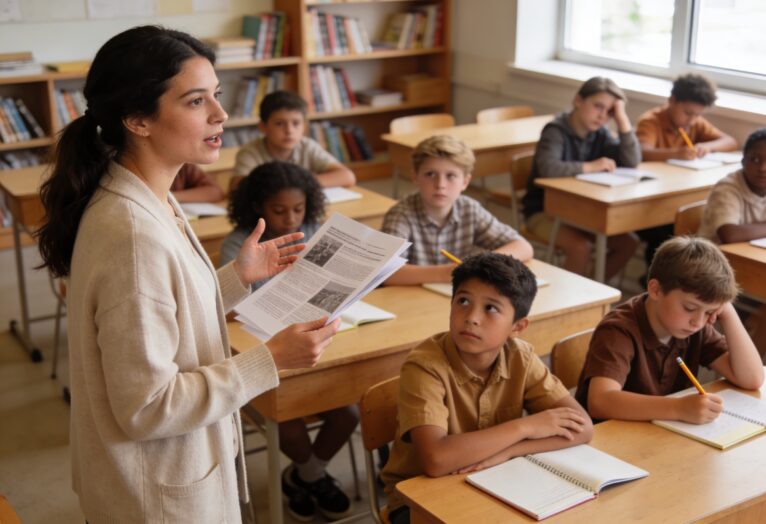
You’ve been there. You spent hours prepping a media literacy lesson you were sure would land. You had the articles, the worksheets, the ‘real vs. fake’ examples. And then… crickets. Blank stares. Or worse, chaos. If you’ve ever felt like your lesson on this critical topic has completely bombed, you are not alone. It’s a story I hear constantly in my work with educators, and the problem often isn’t the teacher—it’s the playbook we’ve been given.
Why your media literacy unit bombed (and why it matters so much)
Teaching digital citizenship to 10- and 11-year-olds is incredibly challenging, and it’s almost never because you’re doing a bad job. The reality is, we’re often working against a powerful current. One of the biggest hurdles is what researchers call the “teacher-student media experience gap.” Many of us grew up with newspapers and nightly news, while our students live in the fast-paced, algorithm-driven worlds of TikTok, Snapchat, and YouTube. When we start a lesson with a traditional news article, their brains might already be checked out because it’s not their native language.
On top of that, fifth graders are still developing the stamina for sustained listening. When a lesson relies too heavily on teacher-led instruction, their active listening batteries drain quickly. This isn’t defiance; it’s a developmental reality. Experts on child learning note that too much talking from the front of the room can lead to students simply switching off.
The stakes for getting this right are higher than ever. We are preparing them for a world where misinformation has serious consequences, which goes far beyond building good digital habits. A recent survey found that a staggering 81% of teens believe at least one disproven conspiracy theory they encountered online. If the old playbook isn’t working, it’s time for a new one.
7 practical fixes for your next media literacy unit
Fix #1: Get in their world (before you teach yours)
Instead of pulling students into our media world, we need to meet them in theirs. The most effective digital literacy lessons connect directly to students’ personal “mediaspheres.” This means starting with the content they already know and care about.
Before you even mention “fake news,” ask them about the YouTubers they watch, the video games they play, or the silly memes they share. A fantastic starting point I’ve seen work wonders is using something as simple as seasonal advertising. Analyzing a hot chocolate commercial or a toy ad for persuasive techniques is far more engaging for a 10-year-old than dissecting an unfamiliar political article. The goal is to build the skill of critical analysis on familiar ground first.
Fix #2: Let them create, not just consume
Passive consumption leads to passive understanding. The moment you turn students into creators, their perspective shifts. They move from being targets of media to understanding how it’s built, which is a much deeper form of literacy.
Instead of just analyzing a website, challenge them to produce their own class newspaper. Suddenly, they have to think about sources, headlines, audience, and layout. Task them with creating a one-minute TV commercial for a school event. They’ll have to grapple with persuasive language, target demographics, and emotional appeals. Even a simple activity like dissecting and then designing their own logos forces them to think about how a single image can communicate a complex message. Creation is the ultimate decoding tool.
Fix #3: Ask “who & why,” not only “real or fake?”
Focusing on a simple “real or fake” binary is a tempting but limited framework. A message can be factually true but still be manipulative. A more powerful approach is to shift the focus from fact-checking to investigating intent. The goal is to help students understand how messages are constructed and for what purpose.
Equip them with a core set of investigative questions that media literacy experts recommend. Every time they see a post, a video, or an ad, train them to ask:
- Who made this?
- Who is the target audience?
- Who might benefit from this message?
- Who might be harmed by it?
These questions transform them from passive receivers into active detectives, digging for the story behind the story.
Fix #4: Use breaking news (carefully)
When a major event happens, it creates a real-time laboratory for watching information—and misinformation—spread. Using current events can make media literacy feel urgent and relevant, but it must be done with care and age-appropriateness.
For example, high school teacher Conor Murphy used the Notre Dame Cathedral fire to show his students how quickly false narratives, propaganda, and conspiracy theories took hold on social media. For fifth graders, you could use a less traumatic event, like a viral video trend, a major sports game, or even a weather event, to track how different sources report on the same story and how user comments can shape the narrative.
Fix #5: Turn the analysis into a game
Anything that feels like a game is an instant win in a fifth-grade classroom. Turn the process of source evaluation into a fun, hands-on challenge.
One highly effective activity is a “Real or Not?” role-playing scenario. Give groups of students a few different online articles or social media posts about the same topic—some credible, some biased, some outright false. Their mission, as “media detectives,” is to investigate the evidence (author, date, sources, URL) and present their case for which source is the most trustworthy and why. Sharing age-appropriate stories about the real-world consequences of misinformation can also add a sense of importance to the “game.”
Fix #6: Turn the lens on themselves
One of the most advanced—but crucial—steps in media literacy is understanding that the lens through which we view the world is not perfectly clear. We all have biases that shape how we interpret information.
You can introduce this concept gently to fifth graders. Use a simple optical illusion to show them how our brains can be tricked. Then, connect that idea to media. Ask questions like, “If you really love a certain video game, would you be more likely to believe good news about it or bad news about it? Why?” The goal isn’t to make them feel flawed, but to empower them with the self-awareness that helps them recognize their own personal biases and approach new information with a healthy dose of curiosity.
Fix #7: Talk less, show more
Finally, let’s address the core problem: “they aren’t listening.” If students are tuning out, it might be a signal to change our delivery method. Reducing teacher talk time is one of the most effective classroom management strategies.
Instead of repeating verbal instructions multiple times, try providing written instructions on the board where students can reference them as needed. This frees you up to circulate and support small groups. Also, embrace the power of silence. Use non-verbal cues like a chime, a bell, or turning the lights off and on to get the class’s attention. It’s often more effective than trying to talk over them, and it saves your voice and your sanity.
A final word of encouragement
I want to be clear: teaching media literacy isn’t about having all the answers. It’s about equipping our students to ask the right questions. It’s messy, it’s constantly evolving, and some days it will still feel like an uphill battle.
But by shifting your approach from lecturing to facilitating, from consuming to creating, and from our world to theirs, you are planting seeds of critical thinking that will serve them for the rest of their lives. Don’t aim for the perfect lesson. Aim for progress. You are doing vital, challenging work, and every small step you take is a victory.
