
Why some questions make a teacher’s heart stop
In my 35+ years of working with schools, I’ve learned that teachers answer hundreds of questions a day. But there are a few that can make even the most experienced educator’s heart stop.
You know the moment. You’re in the middle of a puberty lesson, everything is going smoothly, and a hand shoots up. The question that follows hangs in the air, and suddenly the room is silent. Thirty pairs of eyes are on you, waiting. In that split second, your mind races: What do I say? What am I allowed to say? How do I answer this without causing a problem?
If you’ve felt that wave of panic, you are not alone. This fear of saying the wrong thing is real, valid, and a known professional challenge for educators everywhere. It’s a feeling that extends far beyond the classroom walls. In the high-stakes world of healthcare, for example, communication breakdowns can have severe consequences, leading to everything from malpractice lawsuits to preventable patient harm.
The intensity of a conversation often increases with the level of responsibility. It makes sense, then, that many professionals feel unprepared for these moments. This isn’t just a feeling; research confirms it. A study of health professionals revealed that while a substantial majority (88.1%) expressed a willingness to undergo Health Communication Training (HCT), many reported they had not received adequate training. Your situation as a 5th-grade teacher mirrors this broader professional need.
In your classroom, the stakes feel just as high. A misstep can lead to parent complaints, administrative action, and—most importantly—student confusion or misinformation. You need a reliable strategy to navigate these moments with confidence and care.
A script is your plan, not a crutch
When faced with an “unanswerable” question, the solution isn’t to have all the answers. The solution is to have a plan. This is where a prepared, vetted response—a script—becomes your most powerful tool.
Think of a script not as a rigid mandate that removes your professional judgment, but as a structured framework that builds your confidence. It’s an essential tool for the non-specialist teacher, giving you the precise language to set healthy boundaries while keeping the lines of communication open.
Even experts in health communication rely on structured methods to navigate difficult conversations. Professionals use frameworks and role-playing to practice and prepare for complex or emotionally charged questions. These scripts provide you with that same kind of strategic support. They empower you to maintain classroom control, uphold district policy, and reinforce the vital home-school partnership. You don’t have to be a health expert to handle these moments. You just need a plan.
Five scripts for answering the unanswerable
Here are five word-for-word scripts designed to give you specific, developmentally appropriate language for the toughest questions 5th graders ask. Each one includes a sample question and a brief rationale for why the response is so effective.
The “Too Personal” Question
This happens when a student’s curiosity crosses a professional boundary and veers into your personal life.
Sample Student Question: “Are you married? Have you ever had a baby? What do you think about…?”
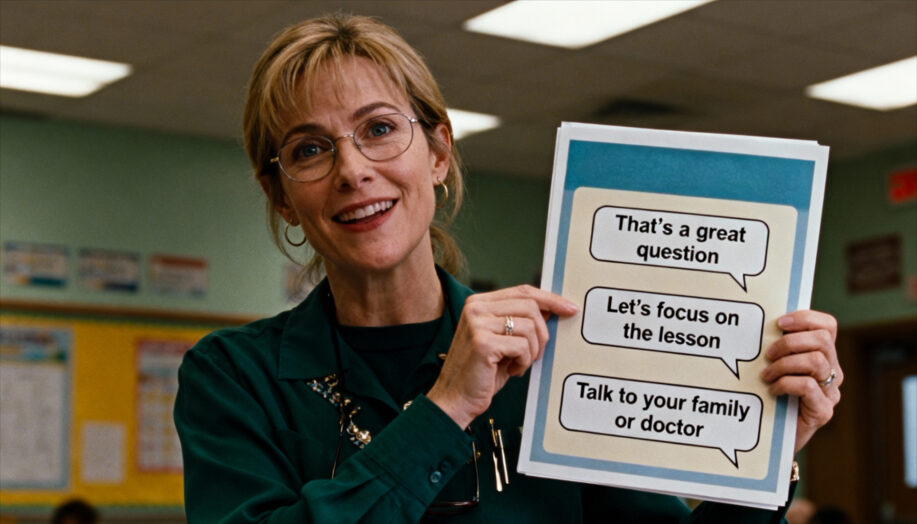
The Script: “That’s a great question that makes me think you’re connecting what we’re learning to people’s real lives. In this class, my job is to teach you the science and health facts. Questions about my personal life are private, so I won’t be answering those. Let’s focus back on our lesson about how the body works.”
Why It Works:
- It clearly and kindly sets a professional boundary without shaming the student for asking.
- It validates the student’s thinking process (“you’re connecting what we’re learning…”) before redirecting.
- It models for students what healthy, appropriate boundaries look like in a professional setting.
The “Off-Topic” Question
This question isn’t bad, it’s just not right for this grade level or the scope of your current lesson.
Sample Student Question: “My older brother talks about [more advanced sexual health topic] – what is that?”
The Script: “I can tell you’re a curious person who is thinking ahead, and that’s a great quality. The topic you’re asking about is something you’ll learn more about when you’re older, in middle school or high school. For our class, we are focusing on the changes that happen during puberty. If you have more questions about that topic, your family or another trusted adult is the best place to have that conversation.”
Why It Works:
- It affirms the student’s curiosity instead of dismissing the question.
- It provides a clear, age-appropriate reason for not discussing the topic right now.
- It empowers the family by reinforcing their role as the primary source for conversations that go beyond the 5th-grade curriculum.
The “Beyond the Curriculum” Question
This is when a student asks for specific medical advice or about a complex, values-laden topic that requires specialized knowledge.
Sample Student Question: “My aunt has PCOS – how does that affect her body during puberty?” or “Is it okay for adults to…?”
The Script: “That is a very thoughtful and specific question. When it comes to personal medical conditions or questions about family values, the best people to talk to are healthcare providers, like a doctor or nurse, and your own trusted adults at home. My role is to teach the general science of what happens to most bodies during puberty, but I’m not able to give medical advice or share opinions on family values.”
Why It Works:
- It acknowledges the student’s question without attempting to provide medical advice, which you are not qualified to do.
- It clearly defines your role as an educator and reinforces the roles of healthcare providers and family.
- It protects you from liability while guiding the student to the correct resources for accurate, personalized information.
The “My Parents Said…” Question
This occurs when a student shares something from home that contradicts the lesson, which could be misinformation or a different family value.
Sample Student Question: “My mom said periods only last two days – is that true?” or “My dad said [a belief that contradicts the lesson] – so the book is wrong?”
The Script: “Thank you for sharing what you’re learning and discussing at home. It’s so important to talk with your family about these topics. In our health class, we learn the medically accurate information that scientists and doctors have found to be true for most people. Families have different beliefs and experiences, and it’s great to continue talking with them about what you learn here. Let’s look at what our lesson says about the typical range…”
Why It Works:
- It respects the family’s role and avoids creating a conflict between home and school.
- It gently but firmly reiterates the school’s commitment to providing medically accurate, science-based information.
- It offers a bridge for family discussion, validating both the home conversation and the classroom curriculum without undermining either one.
The “I’m Worried About…” Question
This is the most critical question to get right. It’s any question that hints at potential abuse, neglect, a serious safety concern, or a significant personal crisis.
Sample Student Question: “My older brother is always touching me in ways I don’t like, is that normal for puberty?” or “I’m really sad all the time because [serious personal problem affecting wellbeing].”
The Script: “Thank you so much for being brave enough to share that with me. That sounds really important, and I want to make sure we talk about it properly. I’m going to have us take a quick break from our lesson, and I’d like you to come talk with me privately for a moment so I can listen better.”
Why It Works:
- It immediately prioritizes the student’s safety and emotional well-being above the lesson plan.
- It creates a safe, private space for the student to talk further, away from the rest of the class.
- It initiates your school’s safety protocol, allowing you to connect the student with the appropriate support, like a school counselor or administrator, as you are a mandated reporter.
Your goal: Partnering with families
As you can see, the goal of these scripts is often to respectfully redirect the conversation back to the student’s family or other trusted adults. This is about actively strengthening the home-school partnership. Parents and caregivers are the primary educators of their children on topics of family values and personal health. Your role is to provide the foundational, medically accurate information that opens the door for those deeper conversations at home.
This partnership is more critical than ever. Research shows that nearly 90% of U.S. adults struggling with health literacy, which means families need the clear, factual foundation you provide in the classroom to help them translate these topics into personal understanding and family values.
By having a plan for the unanswerable questions, you do more than just manage a difficult moment. You build trust, model healthy boundaries, and empower a community of care around every student.
For a complete curriculum that provides you with scripts for every lesson, comprehensive teacher support, and resources for family engagement, explore Puberty: The Wonder Years. You’ll find everything you need to feel prepared and confident.

